

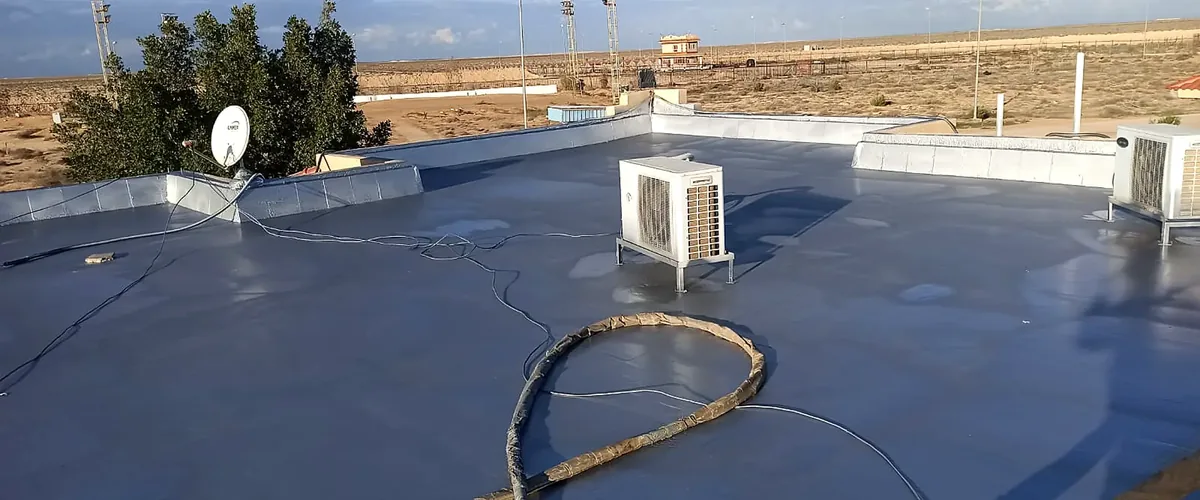
Many Egyptian roofs are already tiled. The tiles look finished, yet water still reaches the ceiling below. Removing them is slow, noisy and expensive. That is why roof waterproofing on tiles has become such a common question. The answer Krypton Chemical documents is simple: do not chase each joint. Instead, cover the whole tiled deck with one continuous, elastic film.
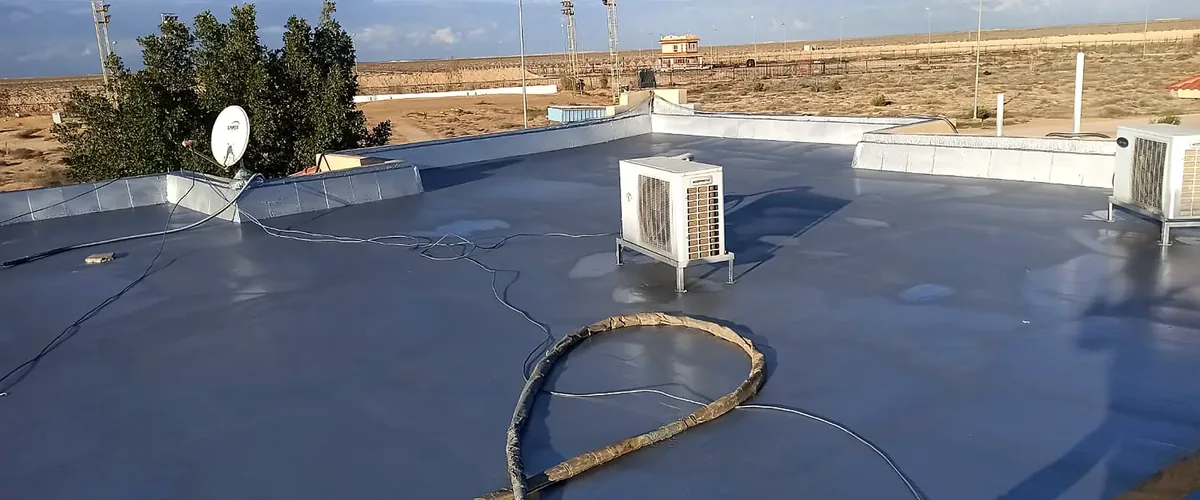
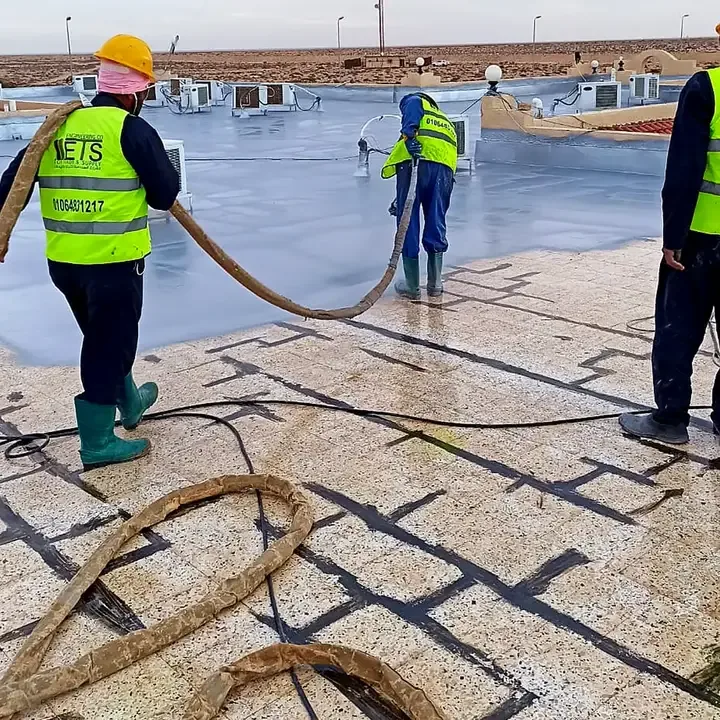
The membrane for this job is Polyurea Rayston, Krypton’s hot-spray pure polyurea. Krypton’s tiled-roof guide describes it as a two-component, 100 percent solids, extra-fast membrane. Once cured, it is a continuous elastomeric film with no joints of its own. In 2021, Khalda Petroleum used it to seal tiled plant roofs in the Western Desert, on the order of 10,000 m².
Why Tiled Roofs Leak Even When They Look Fine
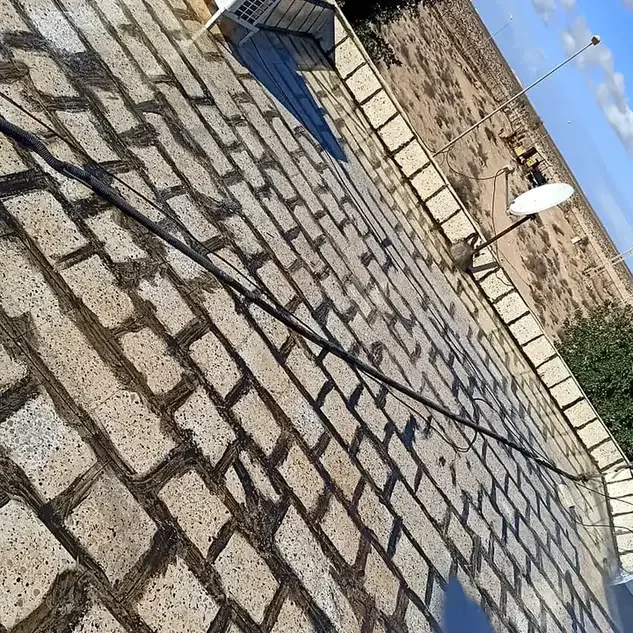
Tiles hide a jointed bed. Water that enters one open joint can travel under many tiles. Then it appears at an outlet, or in a room far from the real defect. As a result, local repairs often miss the source.
Plant roofs make it harder. They carry pipe boots, cable trays, equipment plinths and upstands. Each of these is a place where a sheet lining would need cutting and sealing.
The climate adds stress, too. In the desert, day-to-night movement is large. A brittle coating over tiles will crack at the very joints it should hide. So the membrane must stay elastic, bond through a primer and turn up every detail.
How Roof Waterproofing on Tiles Works with Spray Polyurea
Spray polyurea locks the tile bed, the upstands and the penetrations into one skin. The guide explains that this continuity is why the system belongs over tiles.
Here are the published Polyurea Rayston figures that matter on a tiled deck:
| Property | Official value |
|---|---|
| Elongation | 324% |
| Tensile strength | 16.2 MPa |
| Tear strength | 69 N/mm |
| Dynamic crack bridging | Class B4.2 at 23 °C and −20 °C |
| Hardness | 87A / 35D Shore |
| Approvals | CE to EN 1504-2; ETA 16/0148; BBA 18/5582 (roofing) |
These values let the film follow the deck when temperatures swing, instead of opening at a tile joint. You can verify the European assessment in the EOTA database. The manufacturer’s Polyurea Rayston product page lists the full range.
Roof Waterproofing on Tiles: Step by Step
The steps below follow Krypton’s guide and the Polyurea Rayston TDS.
1. Make the tiled deck sound
First, reset or remove loose tiles. Then remove dirt, oils and laitance. The TDS asks for a cohesive support with pull-off of at least 1.4 N/mm². Moisture must stay under 4%, the deck between 10 and 40 °C, and relative humidity under 85%.
2. Prime
Next, apply the primer, because it is part of the system. If damp is suspected behind the deck, Krypton usually recommends two coats of epoxy primer. The crew blinds the second coat with quartz sand. Metal upstands need cleaning and a polyurethane primer.
3. Spray in one pass
After that, the machine heats the components. Krypton gives about 65 °C on component A, 75 °C on component B and 65 °C in the hose. Pressure at the gun is at least 140 bar. The usual rate is 1.5 to 2.0 kg/m², leaving a film about 1.5 to 2 mm thick.
4. Details in the same film
The crew sprays upstands, outlets and equipment plinths into the same film. Nothing waits for a ring of mastic later. Gel time is about four seconds at 25 °C, so the film stays where it is placed.
5. Protect from the sun
Finally, add the topcoat. Polyurea Rayston is aromatic, so its colour can shift in sunlight while strength remains. Therefore, an aliphatic finish such as Impertrans or Colodur goes on before the first hard summer.
The Khalda Petroleum Case in the Western Desert
Krypton’s guide documents a real Egyptian site. Khalda Petroleum had tiled plant roofs sealed in its concession, including Abu Gharadig and Tariq Gas Field. The work dates from 2021 and covers about 10,000 m². ETS, the Engineering Co. for Trade and Supplies, carried out the application with Krypton systems.
The plant kept working during the job. Afterwards, the tiled deck became a single waterproof skin. Joints that used to carry water now sit under a continuous polyurea film. Moreover, the same concession used other Krypton systems for different exposures, such as an evaporation pond and foam-insulated villa roofs.
When Is Roof Waterproofing on Tiles the Right Choice in Egypt?
This route suits a sound tiled roof that leaks at joints and details. It saves the cost of breaking, removing and carting tiles away. It also spares residents, hotel guests or a working plant from weeks of noise.
However, it is not for every roof. If large areas of tiles are hollow, or the slab itself is damaged, repair comes first. Likewise, if moisture sits under the tiles, you need a suitable primer. For that reason, we always start with a site survey and a moisture check, and only then specify roof waterproofing on tiles.
Common Mistakes on Tiled Roofs
- Spraying over loose or hollow tiles instead of fixing them first.
- Skipping the primer on a damp deck.
- Leaving upstands and plinths for a separate sealant.
- Leaving an aromatic film bare in strong sun.
In short, the membrane is only as good as the preparation under it. Our surface preparation guide covers primers and moisture in more detail.
Related Reading on Krypton Egypt
If you are choosing between spray systems, read pure vs hybrid polyurea roofs. And if your roof has old bitumen sheets, see bituminous membrane failure. To compare all routes, use Krypton’s tool to choose your waterproofing system.
FAQ
Do I have to remove the old tiles?
Not if they are sound. At Khalda, the crew sprayed over the tiles after preparation.
How fast does it set?
The guide states a gel time of about four seconds at 25 °C. Light traffic follows in hours, while full hardness takes days.
Conclusion: One Film Instead of a Thousand Joints
Reliable roof waterproofing on tiles does not chase joints. It covers them. Polyurea Rayston turns the tile bed, upstands and plinths into one elastic skin, as Khalda Petroleum’s roofs show. Download the TDS, check your tiles, and ask Krypton Egypt for a technical quote.
No comment