

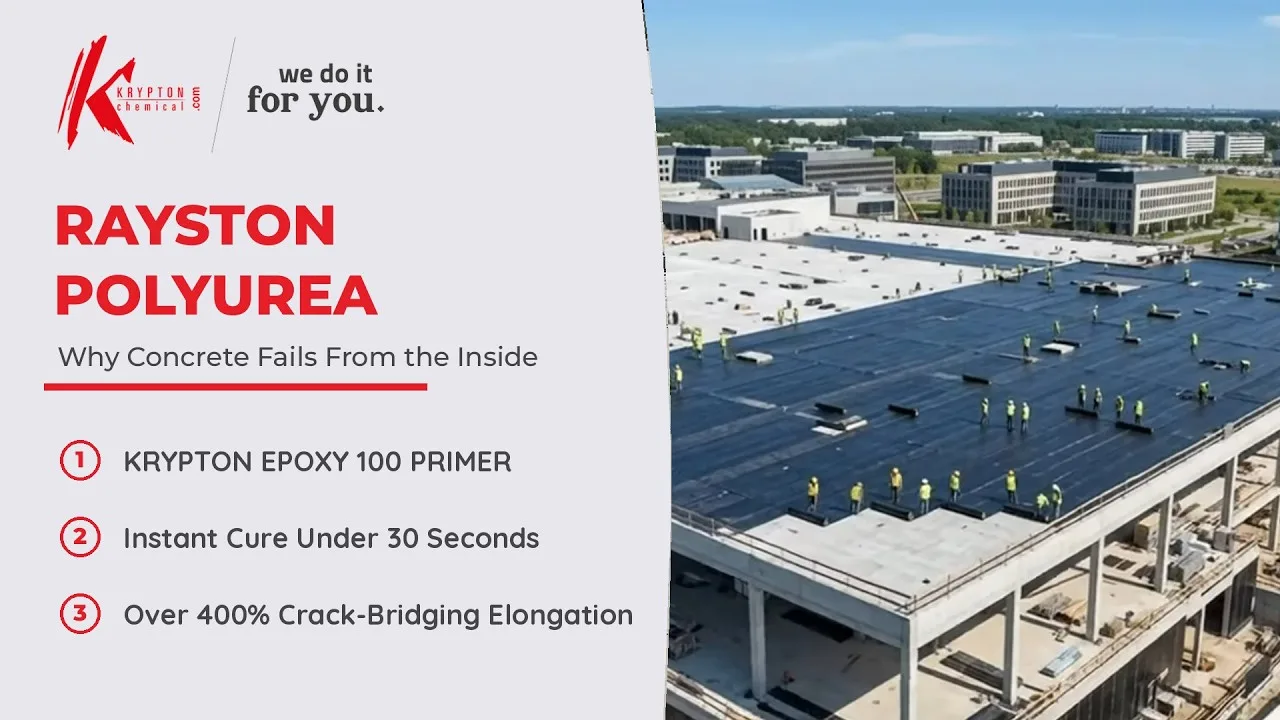
A roof can look perfect and still leak. That is the hard lesson behind most bituminous membrane failure cases on Egyptian roofs, basements and podium decks. The water does not wait for a visible tear. Instead, it enters at a seam, travels under the sheet and appears metres away, often as a stain on a finished ceiling. Krypton Chemical’s new 3D explainer shows this hidden path step by step. It also shows the alternative: a primed, hot-sprayed pure polyurea membrane with no seams at all.
How Bituminous Membrane Failure Starts: Seams and Hollow Voids
Sheet and torch-on membranes are made of overlapping pieces. Every overlap is a joint, and every joint is a possible entry point. On a large slab, that means hundreds of linear metres of seams, all welded by hand.
Bond is the second weak point. When the sheet does not adhere fully to the concrete, hollow voids form beneath it. As a result, water that gets in has room to move. It migrates laterally under the sheet, so the leak inside the building rarely sits under the actual defect. For the maintenance team, that turns a small repair into a long search.
Five Mechanisms of Bituminous Membrane Failure in the Video
The explainer breaks the problem into clear chapters. Here is what each one means on site.
1. Hydrostatic pressure and lateral migration
Below ground, water pushes against retaining walls and slabs. If the membrane is not bonded, that pressure drives water behind the sheet. From there, it tracks across the foundation until it finds a crack.
2. Vapour blistering and settlement
Moisture trapped under an unbonded sheet turns to vapour in strong sun. The pressure lifts the membrane into blisters. Meanwhile, differential settlement stretches rigid sheets until they tear.
3. Torch-on seams at parapets
A 90° parapet is the hardest detail for an open flame. Uneven melting leaves micro-gaps and curled edges exactly where water collects.
4. Fasteners and concealed leaks
Every mechanical fixing punctures the membrane. Water enters at these points and then travels along voids before it shows up as a ceiling leak.
5. Rebar corrosion, spalling and UV damage
Once water reaches the slab, embedded steel starts to corrode. Rust expands, so the concrete cracks and spalls from the inside. On top of that, backfill can scratch buried sheets, and UV ages exposed bitumen at expansion joints.
Why Egypt’s Climate Speeds Up Bituminous Membrane Failure
Egypt’s climate makes these mechanisms work harder. Krypton’s own case study at Cairo International Airport describes “a hard sun on a wide concrete deck” and a slab that “moves between noon and night”. Daily thermal cycling like this fatigues seams and turns trapped moisture into vapour. In other words, the same heat that makes a roof uncomfortable also speeds up every weakness above.
The Fix: Rayston Epoxy 100 Primer + Polyurea Rayston
The video’s solution has two layers. Each one does a separate job.
Step 1: Rayston Epoxy 100 locks into the concrete
Rayston Epoxy 100 is a two-component, high-solids, low-viscosity epoxy primer (the video calls it Krypton Epoxy 100 Primer). Its TDS positions it for waterproofing and paving polyurethanes on substrates with humidity below 4%. It is applied at 200 to 500 g/m² by brush or roller, and its listed adhesion strength on concrete is 5.0 MPa. On large areas, the TDS recommends broadcasting quartz sand to create a rougher key for the next coat. For full surface preparation advice, see our polyurea surface preparation and primer guide.
Step 2: Polyurea Rayston forms one continuous membrane
Polyurea Rayston is a two-component pure polyurea, applied only with hot spraying equipment. Its gel time is about 4 seconds at 25 °C, and it is tack-free in 30 seconds at 70 °C. Because it is sprayed, the film wraps around pipes, upstands and parapets with no laps to weld. Consequently, there are no seams for water to enter.
Polyurea Rayston Technical Data (Official TDS)
All figures below come from the official Polyurea Rayston TDS (update 21/07/2026).
| Property | Value | Standard |
|---|---|---|
| Typical application | 1.5–2.0 kg/m² (1.5–2 mm) | TDS |
| Gel time (A+B, 20 g) | 4 s at 25 °C; 3 s at 60 °C | TDS |
| Tack-free time | 30 s at 70 °C | TDS |
| Rain resistance | After 10 min (25 °C, 50% RH) | TDS |
| Maximum elongation | 324% | UNE EN ISO 527-1/3 |
| Tensile strength | 16.2 MPa | UNE EN ISO 527-1/3 |
| Tear strength | 69 N/mm | ISO 34-1 method B |
| Hardness | 87A / 35D | ISO 868 |
| Adhesion, concrete with epoxy primer | 4.0 MPa | TDS |
| Static crack bridging | Class A5 at −10 °C | EN 1062-7 method A |
| Dynamic crack bridging | Class B4.2 at 23 °C and −20 °C | EN 1062-7 method B |
| Watertightness | Watertight at 5 bar (50 m water column) | EN 12390-8 |
| Liquid water permeability | 0.002 kg/m²·h0.5 | EN 1062-3 |
What the Concrete Needs Before Spraying
A seamless membrane still depends on its substrate. Therefore, the TDS sets clear limits:
- Pull-off strength of at least 1.4 N/mm².
- Substrate moisture below 4%.
- Support and air temperature between 10 °C and 40 °C, with relative humidity below 85%.
- Mechanical preparation to open the pore, with cracks repaired first.
If underlying moisture is suspected, the Polyurea Rayston TDS recommends two coats of Rayston epoxy primer, the second with a quartz sand broadcast. The Epoxy 100 TDS also warns against applying on hot surfaces. On an Egyptian summer roof, that usually means priming in the cooler hours. Polyurea is then sprayed only after the primer has fully cured.
Exposed Roofs: Add a UV Topcoat
Polyurea Rayston is aromatic, so its colour changes in sunlight. According to the TDS, this does not affect mechanical properties. Where colour stability matters, an aliphatic polyurethane topcoat such as Impertrans or Colodur is applied on top. Comparing systems for a roof? Read our pure vs hybrid polyurea roof guide, and see Krypton’s hybrid hot-spray option, Impermax Polyurea H.
Certifications and Proof on Egyptian Projects
Polyurea Rayston carries CE marking to EN 1504-2 (0370-CPR-2247) and a European Technical Assessment, ETA 16/0148 under ETAG 005. You can check ETAs through the EOTA database. It also holds BBA certificate 18/5582 for roofing and WRAS approval 2208579. The full list is on the Krypton certificates page and the official Polyurea Rayston product page.
In Egypt, Polyurea Rayston waterproofed the roofs of the Ministry of Aviation and Seasonal buildings at Cairo International Airport in 2020–2021. In addition, hot-spray pure polyurea closed the roof of the Mövenpick Hotel in 6th of October City in 2021. For below-ground work, see our polyurea foundation waterproofing guide.
FAQ
Why does a bituminous membrane leak far from the defect?
Because poor bond leaves voids under the sheet. Water enters at a seam or fastener, then migrates laterally before it reaches the slab.
How thick is a Polyurea Rayston membrane?
The TDS gives 1.5 to 2.0 kg/m², which builds 1.5 to 2 mm in a single application.
Can Polyurea Rayston be sprayed on damp concrete?
The TDS requires moisture below 4%. If damp is suspected, apply two coats of epoxy primer first, the second with quartz sand.
Does the membrane need UV protection?
On exposed roofs, yes, if colour matters. An aliphatic topcoat (Impertrans or Colodur) keeps the finish stable.
Conclusion: Stop Bituminous Membrane Failure at the Source
Bituminous membrane failure is rarely one big tear. Rather, it is many small seams, voids and punctures working together. A primed, monolithic Polyurea Rayston membrane removes those paths, and its figures are documented in an official TDS. Watch the explainer, download the data sheets and send us your roof or basement details. The Krypton Egypt technical team in Cairo will help you specify the right build-up.
No comment