

Most leaks in Egyptian apartments do not start on the roof. They start in a bathroom, and they show up on the neighbour’s ceiling below. Good bathroom waterproofing stops that water before it reaches the slab. It is not a coat of paint under the tiles, however. It is a continuous membrane that runs from the floor up the wall, around every drain and into every corner.
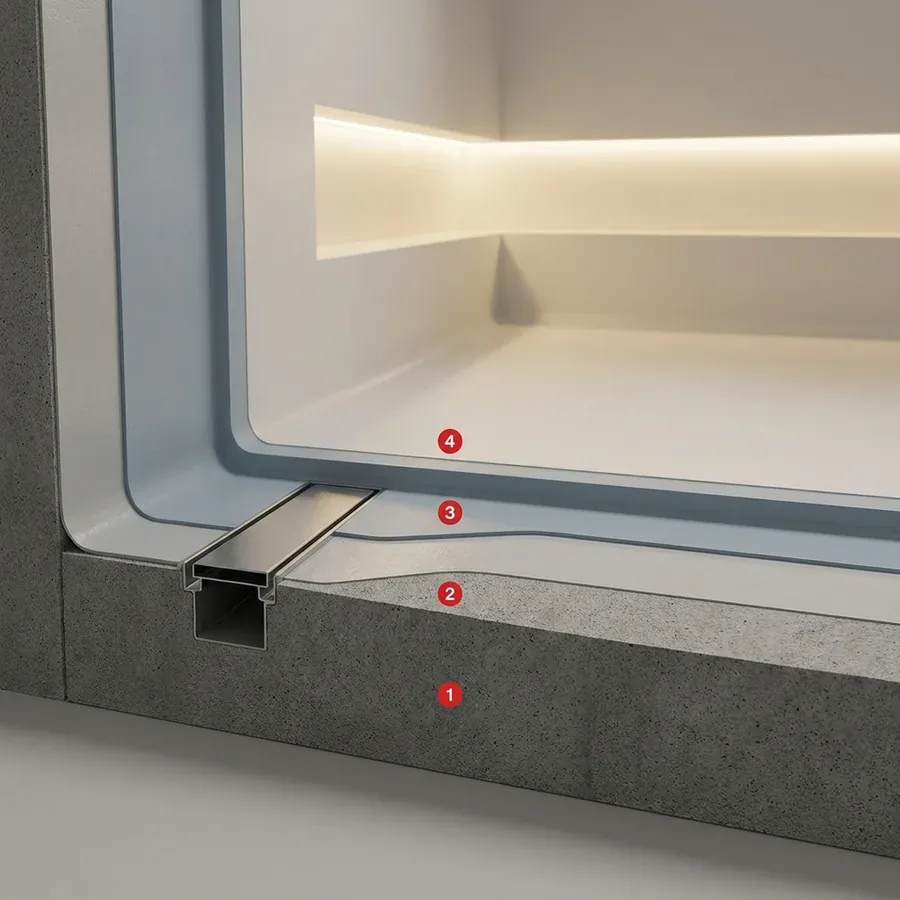
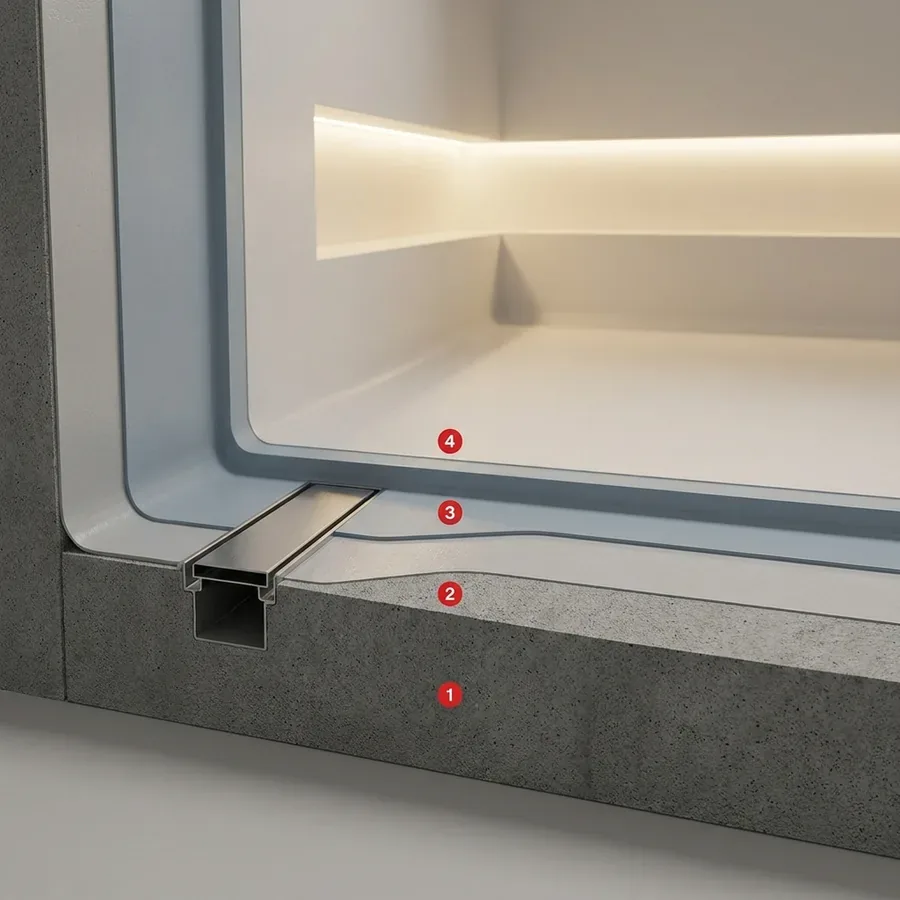
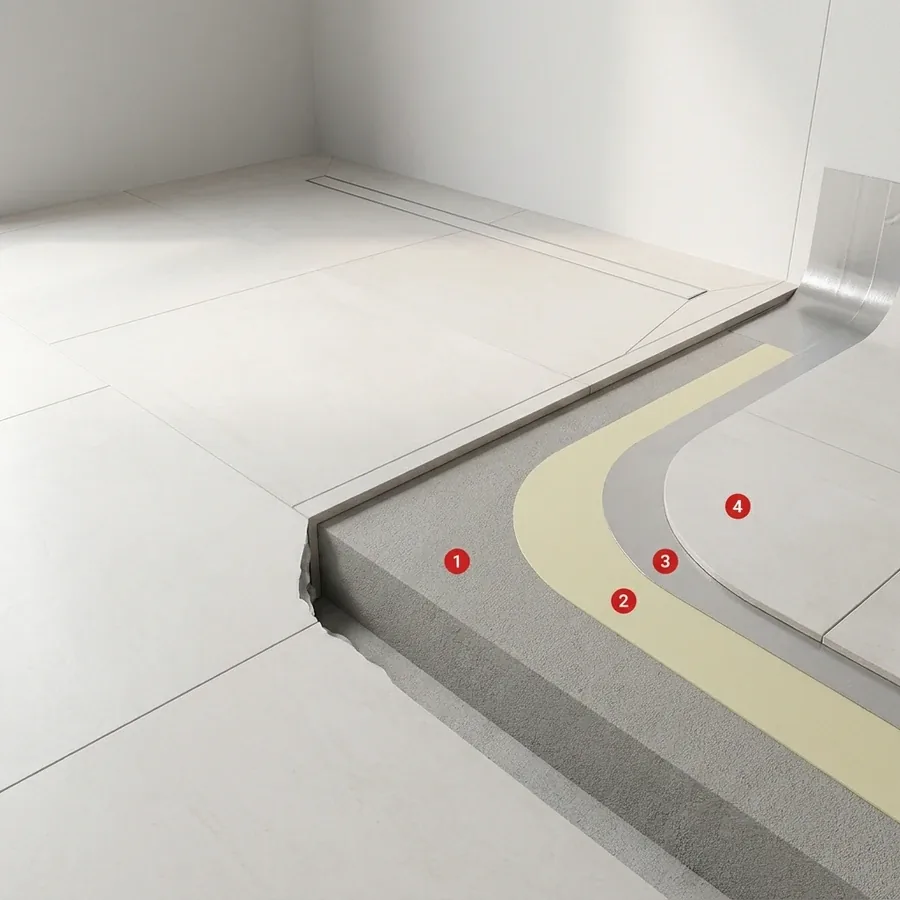
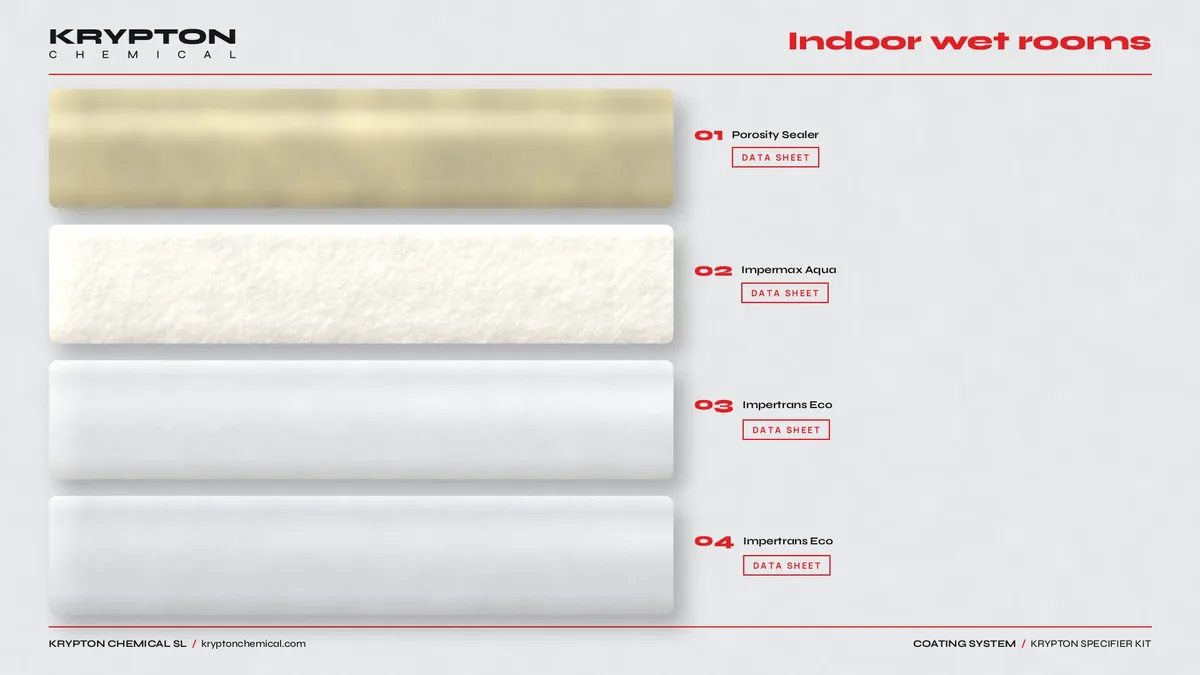
For this job, Krypton Chemical’s official reference is Impermax Aqua 2K, a solvent-free, two-component polyurethane membrane. The Indoor Wet Rooms application page lists the build-up: a cementitious screed, then Rayston Epoxy 100 primer, then the Impermax Aqua membrane, then porcelain tiles. Because it contains no solvents, the TDS states it suits indoor and poorly ventilated rooms. That matters in a small bathroom with one window, or none.
Why Bathroom Waterproofing Fails in Egyptian Buildings
A bathroom is a hard place for any material. Water splashes every day. Cleaning products hit the floor. The room heats up with every shower and then dries again. Krypton’s wet-room page names this wet–dry cycling as the core load.
Still, the open floor is rarely the problem. Leaks come from the details. These are the usual weak points:
- The joint where the floor meets the wall.
- Corners, thresholds and the door sill.
- Floor drains and shower channels.
- Pipe penetrations, niches and shower trays.
In many Egyptian flats, the bathroom sits directly over a bedroom or a kitchen. So a small gap at a drain becomes a stain, then peeling plaster, then a dispute with the neighbours. For this reason, the detail plan comes first and the product second.
What Impermax Aqua 2K Brings to Bathroom Waterproofing
The figures below come from the official Impermax Aqua 2K technical data sheet. We quote them as published. You can also see the Impermax Aqua 2K product page on the manufacturer’s site.
| Property | Official value |
|---|---|
| Type | Two-component polyurethane, solvent-free |
| Hardness | 66–69 Shore A |
| Elongation at break | >130% |
| Tensile strength | 4 MPa |
| Adhesion to concrete | 1.5 N/mm² (EN 13892-8); 2.5 MPa with Rayston Epoxy 100 |
| Service temperature | −15 °C to 80 °C |
| CE marking | EN 1504-2 (0370-CPR-2247) |
In addition, the TDS says the cured membrane stays stable even in permanent immersion. It also lists concrete, mortar, ceramics and fibreglass-reinforced polyester as suitable substrates. As a result, the same membrane can cover a new screed or an old tiled floor after proper preparation.
Krypton’s knowledge note on kitchens and showers with Impermax Aqua 2K adds a useful point. The membrane can sit under tiles, or it can stay exposed with a solvent-free finish such as Impertrans Eco.
Bathroom Waterproofing Step by Step
The sequence below follows the TDS and the official wet-room page. Always check the current data sheet before you start.
1. Check the substrate
First, the base must be sound. The TDS asks for a cohesive strength of at least 1.5 MPa and a compressive strength of at least 25 MPa. Moisture must stay below 4%. Also, there must be no water pressure from below. On a new slab, wait at least 21 days.
2. Prepare and prime
Next, open the surface by sanding or blasting. Then apply a suitable primer. On the official build-up, that primer is Rayston Epoxy 100. With it, the TDS reports adhesion of 2.5 MPa on concrete.
3. Detail before the field
After priming, treat the floor–wall joint, corners, drains and pipes. These lines carry most of the risk. On walls, the TDS recommends Thickening Additive so the membrane does not sag. Where thick layers are needed, Geomax reinforcement can be added.
4. Mix and apply
Mix component A and B at 100:38 by weight. Then spread quickly with a squeegee or toothed spreader. A spiked roller removes bubbles, ideally within ten minutes. One coat can reach up to 1.5 kg/m², about 1 mm thick. Pot life is 45–50 minutes at 18 °C and 40% RH.
5. Cure, test, then tile
Finally, let it cure. At 18 °C and 40% RH, light traffic is possible after 24 hours and full cure takes two days. Then inspect continuity at every detail before the tiler starts. Krypton’s page says the room should be released only when project requirements are met.
Bathroom Waterproofing in Egypt: Heat, Humidity and Timing
Egyptian summers are hot, and coastal cities are humid. Both affect any resin. The TDS sets the working window at 10–30 °C air temperature and below 60% relative humidity. The substrate should stay between 10 °C and 25 °C.
So, on a hot day in Cairo, start early or work after sunset. In Alexandria or on the Red Sea coast, watch the humidity closely. If moisture is high, Krypton advises a suitable primer recommended by its technical team. In short, plan the weather before you plan the crew.
Common Bathroom Waterproofing Mistakes to Avoid
Krypton’s wet-room page lists three typical errors. We see the same ones on Egyptian sites:
- Treating the open floor as the whole job and skipping drains, corners and thresholds.
- Applying over a damp or dirty base without a moisture check.
- Tiling before checking thickness, adhesion and continuity at the wet details.
Another mistake is using the wrong product for the wrong water. A shower is not a swimming pool. For chlorinated pools, Krypton names a different system. You can read our guide to polyurea pool coating for that case.
Related Reading on Krypton Egypt
If you are comparing chemistries, see polyurea vs polyurethane waterproofing. For primers and moisture limits, our surface preparation guide explains the basics. Not sure which route fits your room? Use Krypton’s tool to choose the right waterproofing system by area, substrate and exposure.
Frequently Asked Questions
Can I apply it over old tiles?
The TDS lists ceramics as a suitable substrate. However, the tiles must be sound, clean and prepared, and a primer is required.
Does the membrane need a top layer?
Not always. It can be tiled, or left exposed with a solvent-free finish like Impertrans Eco, as Krypton’s note explains.
Which certifications does it carry?
The TDS lists CE marking to EN 1504-2 and a drinking-water contact test by the Applus laboratory. The EN 1504 family is published through CEN-CENELEC.
Conclusion: Seal the Details, Then Tile
Reliable bathroom waterproofing is about continuity. One seamless, solvent-free membrane must cover the floor, the joints and every drain. Impermax Aqua 2K over Rayston Epoxy 100 gives that build-up, with figures published in an official TDS. Download the data sheets, check your site conditions, and then talk to the Krypton Egypt team. We will help you choose the right system for your project.
No comment