

A roof dries out between storms. A planter never does. The soil stays wet, roots keep searching for water, and fertilisers add salts to every litre of irrigation. That is why planter box waterproofing needs a membrane built for permanent wet soil. A membrane designed for rain alone is not enough. This guide explains how spray polyurea handles that duty, using one of Egypt’s most visible landscape projects. Krypton’s page on waterproofing gardened roofs sets the wider system logic.
Why planter box waterproofing fails
Most planter leaks come from four causes. First, the membrane sits in wet soil all year, so any weak bond turns into a leak. Second, roots exploit every lap, pinhole and gap. Third, irrigation water and fertilisers bring chemicals that slowly attack weaker materials. Finally, every planter has upstands, inside corners, drains and pipe sleeves.
With sheet membranes, however, each of those details needs a cut, a lap and a seal. In contrast, a liquid membrane goes on as one continuous skin, so it has no laps at all.
Spray polyurea for planter box waterproofing
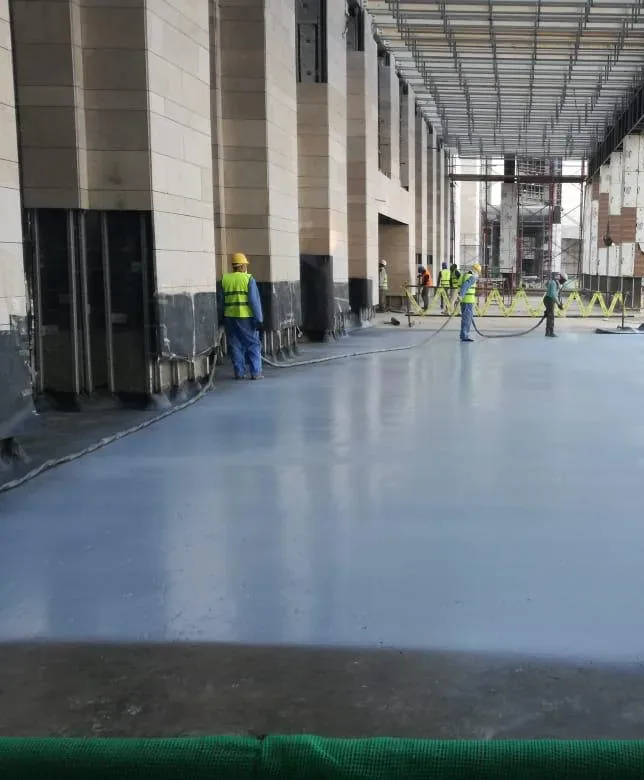
Polyurea Rayston is Krypton’s hot-spray pure polyurea. Its TDS gives a gel time of 4 seconds at 25 ºC. As a result, it builds an even film on vertical upstands. It also turns corners at the same thickness as the floor.
In particular, several values in the datasheet speak directly to planters:
- Root resistance: tested according to CEN/TS 14416:2014.
- Watertightness: 5 bar, equal to a 50 m water column (EN 12390-8).
- Fertiliser chemicals: in the TDS immersion test, urea and ammonium nitrate both score 5, the best rating, after 24 days at 80 ºC.
- Elasticity: maximum elongation of 324% and tensile strength of 16.2 MPa.
- Certifications: CE marking to EN 1504-2 and ETA 16/0148.
The root test reference is a European technical specification. You can learn how such documents are published on the CEN-CENELEC website.
Impermax for edges and hard-to-reach details
A spray gun cannot reach everything. Small planters, tight edges and junctions near finished stone are often easier to treat by roller or brush. For those spots, Krypton pairs the polyurea with Impermax.
According to its TDS, Impermax is a one-component liquid polyurethane membrane that cures into a cold-applied elastomeric film. It lists a maximum elongation of 450–600%. Moreover, it holds root perforation certificates, including Nº 07/32305556 without reinforcement. It also carries ETA 06/0263 with CE marking for 10 and 25 years.
Planter box waterproofing in Egypt: the Ministries District
The New Administrative Capital is Egypt’s new seat of government. At its heart, the Ministries District combines public squares, gardens and water features. All of them sit above or around buildings that must stay dry.
In 2020 and 2021, the contractor ETS applied Krypton spray polyurea and Impermax there. In total, the work covered about 20,000 m² of planters, landscape areas and water features. The full story is on the Ministries District landscape waterproofing project page.
Moreover, the project page explains the climate challenge. Concrete in the desert heats up under strong sun and cools at night. Consequently, hairline cracks open and close, and the membrane has to follow them while staying bonded.
Step-by-step planter box waterproofing
- Survey the planter: map drains, sleeves, upstands and joints before choosing materials.
- Prepare the concrete: the Polyurea Rayston TDS asks for a pull-off of at least 1.4 N/mm² and moisture below 4%. In addition, the support temperature must stay between 10 ºC and 40 ºC.
- Prime: Krypton’s gardened roof page names Polyurea Primer among its reference products.
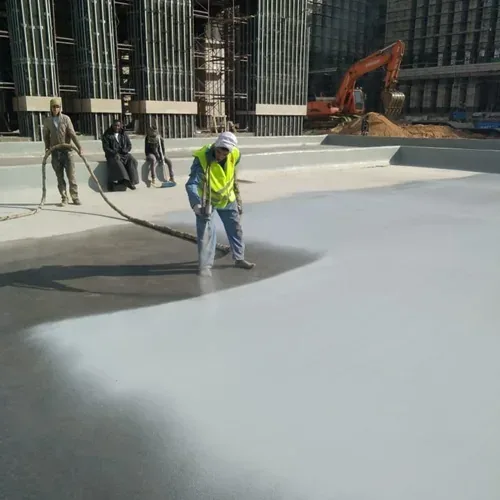
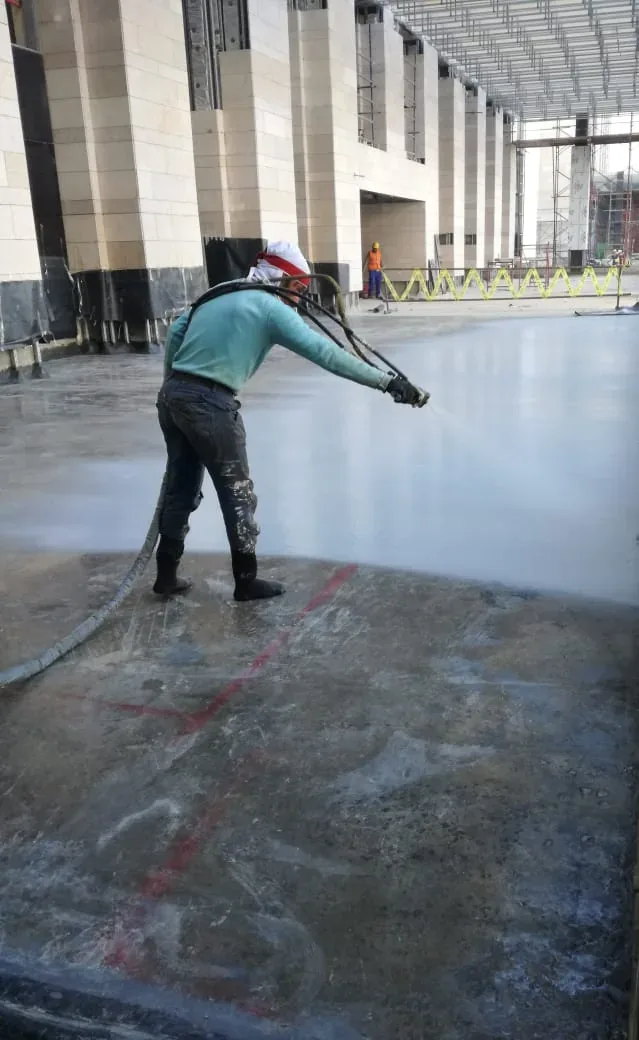
- Spray the membrane: next, spray at the usual TDS rate of 1.5 to 2.0 kg/m², or about 1.5 to 2 mm.
- Treat small details: use Impermax by roller or brush where spraying is not practical.
- Protect before backfilling: wait until the membrane hardens. The TDS hardness table rises from 70 Shore A after 1 hour to 88 after 4 days.
Does a buried membrane need a UV topcoat?
Polyurea Rayston is based on an aromatic isocyanate, so its colour changes in sunlight. Its TDS states that this does not affect the mechanical properties. Under soil, the membrane sees no sun once you backfill. On the other hand, exposed upstands above the soil line can take an aliphatic topcoat. For UV protection, the TDS names Impertrans or Colodur.
Krypton’s note on green roofs specified as a system makes a related point. A green roof combines a waterproofed roof, a root barrier and a drainage build-up. Even so, the current datasheet of each product remains the reference.
Planter box waterproofing on roofs: the hybrid option
Some planters sit on large roof decks rather than in landscape bays. In that case, the gardened roof page also names Impermax Polyurea H, a hot-spray hybrid polyurea. Its TDS includes a certificate of resistance to root penetration based on EN 13948. Furthermore, it lists ETA 11/062, with W3 and 25 years when protected by Impertrans Pigmented topcoat. For this reason, it suits planted roofs that also face sun and foot traffic.
Frequently asked questions
Which membrane is best for planter box waterproofing?
Choose a continuous, root-resistant liquid membrane. Polyurea Rayston is tested to CEN/TS 14416:2014, and Impermax holds its own root perforation certificates.
Can I use the same system on a basement roof slab?
Often, yes. Buried slabs face similar water and soil pressure, as our guide to polyurea foundation waterproofing explains.
What about planters on an exposed roof terrace?
The exposed parts face sun and heat as well. Our comparison of pure and hybrid polyurea for roofs helps you choose the roof membrane.
For more background, read Krypton Chemical’s article on green roofs and sustainable waterproofing. To plan a planter or landscape project in Egypt, contact the Krypton Egypt team.
No comment