

A concrete drinking water tank works in constant immersion, hydrostatic pressure and fill-and-drain cycles, and on Egyptian rooftops and in pump rooms it also deals with summer heat. Choosing a polyurea water tank coating is therefore an engineering decision that affects both the life of the structure and the safety of the water it stores. This guide explains how Krypton’s polyurea lining system for drinking water tanks is specified and applied, and which numbers a specifier should ask for before work starts.
Why conventional tank linings fail
Most leaks in concrete tanks start at the same weak points: shrinkage and thermal cracks, wall-to-floor junctions and joints, and pipe penetrations. Rigid or very thin coatings crack along with the concrete. Sheet systems, on the other hand, leave laps that can open over time. What a potable water tank actually needs is a liner that is:
- seamless, covering floor, walls and corners in one continuous membrane;
- flexible enough to bridge moving cracks;
- watertight under pressure and in permanent immersion;
- independently approved for contact with drinking water, rather than just described as “safe”.
Why pure polyurea suits potable water tanks
Polyurea Rayston is a two-component pure polyurea, hot-sprayed with a plural-component machine. It gels in about 4 seconds at 25 °C. As a result, it builds thickness on vertical walls without sagging, and the tank can return to service quickly. According to the technical data sheet:
- Elongation at break: 324%. Tensile strength: 16.2 MPa. Tear resistance: 69 N/mm.
- Watertight up to 5 bar, equal to a 50 m water column (EN 12390-8).
- Liquid water permeability: 0.002 kg/m²·h0.5 (EN 1062-3).
- CE marked to EN 1504-2 for concrete protection.
WRAS approval: read the conditions
For drinking water, contact approval is what matters most. Polyurea Rayston appears in the WRAS approvals directory under BS 6920, approval number 2208579. In other words, the cured liner does not leach toxic metals, does not promote microbial growth and does not affect taste or odour.
Krypton’s note on WRAS-approved lining for drinking water reservoirs explains the conditions that every specification should include:
- The approval covers the blue colour only.
- It also covers water up to 60 °C.
- Only Krypton-authorised, trained applicators may install the liner.
However, the approval does not automatically extend to hybrid or cold-applied polyureas.
Step by step: lining a concrete tank with polyurea
1. Assess and prepare the concrete
Surface preparation follows EN 1504-2. First, remove laitance, oil and dust until you reach sound concrete. Typical European site practice then calls for:
- a pull-off strength of at least 1.5 N/mm²;
- concrete moisture below 4%, or up to 8% with a dedicated humidity-tolerant primer.
Krypton presents these as general site practice rather than TDS values. In ground tanks, moisture can also come from the soil behind the wall, so measure it instead of judging by eye.
2. Prime
Next, apply an epoxy primer at roughly 0.2–0.4 mm dry film thickness. This can be Rayston Epoxy 100, or a humidity-tolerant primer when moisture requires it. The primer seals pores, reduces pinholes and locks in adhesion.
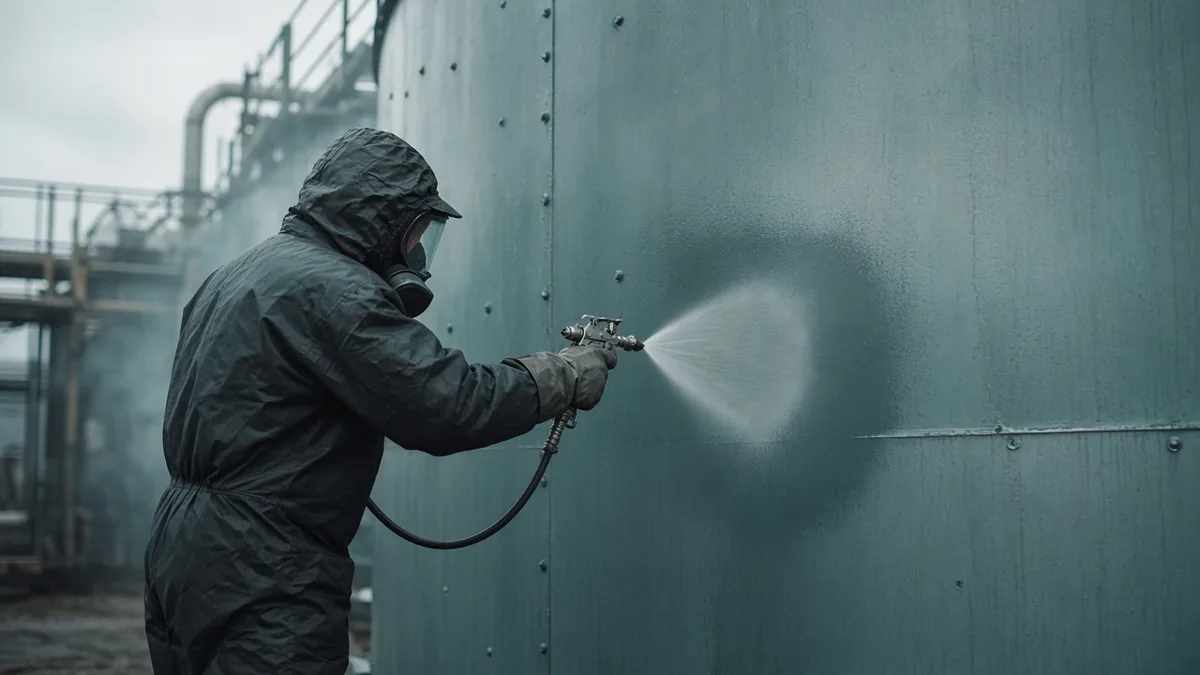
3. Spray the membrane
Spray Rayston at about 1.8–2 kg/m² (around 1.9–2 mm), at roughly 65–75 °C and at least 140 bar. Then detail the corners and pipe penetrations carefully. According to the TDS:
- substrate temperature must stay between 10 and 40 °C;
- substrate moisture must stay below 4%.
On sun-exposed roofs in an Egyptian summer, substrate temperature can exceed the upper limit. For this reason, measure it and schedule early-morning work.
4. No internal UV topcoat
Inside an enclosed tank the liner never sees sunlight, so it needs no aliphatic topcoat. Aliphatic finishes such as Impertrans or Colodur are only for polyurea that sees UV.
When a cold-applied liner makes more sense
Small tanks with tight access may not allow a spray rig inside. For these cases Krypton offers Impermax Aqua 2K, a cold-applied alternative for use at a minimum of 2 kg/m². It is CE marked to EN 1504-2 and referenced to Directive 98/83/EC. Its certifications are its own, because the Rayston WRAS approval does not transfer to it. The drinking water reservoir systems page compares the options.
Checklist for owners and engineers
- Name the exact product and colour (blue Polyurea Rayston) and the WRAS number in the contract, not just “polyurea”.
- Ask for proof that the applicator is Krypton-authorised, because the approval depends on it.
- Record moisture, substrate temperature and pull-off results before spraying.
- Finally, check the current data sheet in the Krypton Chemical certifications and documents library.
For local supply and support, see polyurea waterproofing by Krypton Egypt and our certifications page.
FAQ
Is polyurea safe for drinking water tanks?
Blue Polyurea Rayston holds WRAS approval 2208579 (BS 6920) for water up to 60 °C when Krypton-authorised applicators install it. Any other product needs its own approval.
How thick should a polyurea tank lining be?
The recommended practice for Rayston is 1.8–2 kg/m² (about 2 mm) over a 0.2–0.4 mm epoxy primer.
Does the liner need a topcoat?
Not inside an enclosed tank. Aliphatic topcoats are only for UV-exposed surfaces.
Can you line a damp tank?
Only if moisture is below 4%, or up to 8% with a humidity primer. Before that, remove all standing water.
No comment