

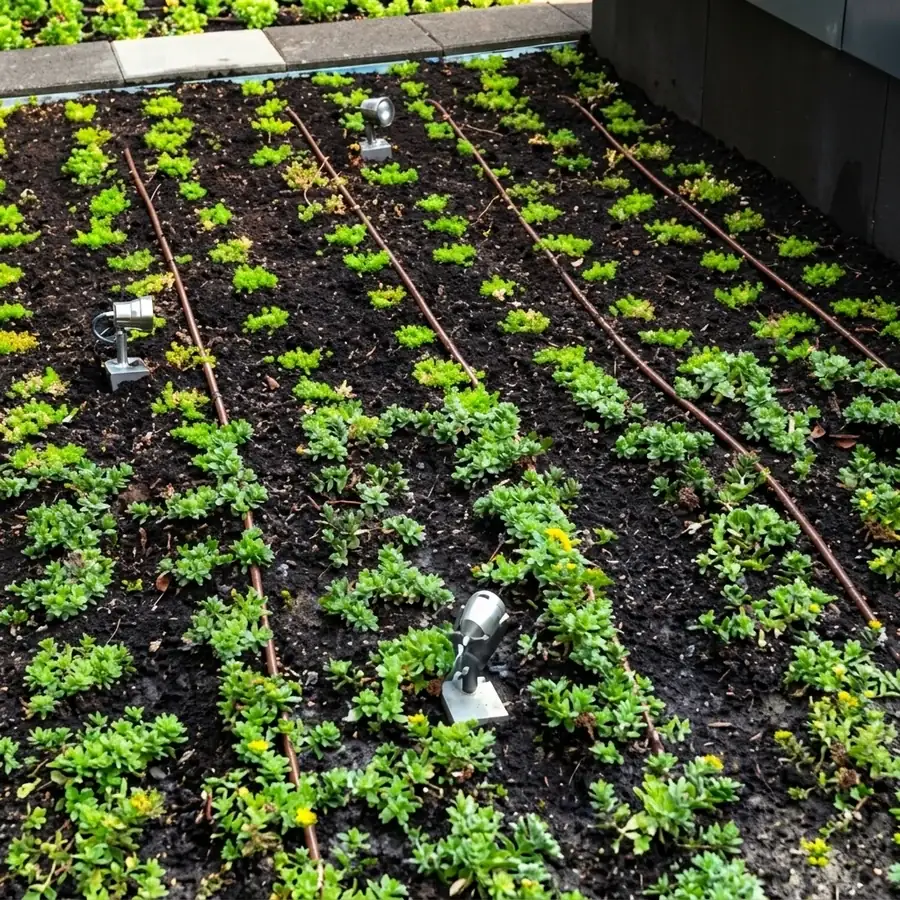
A planted roof never dries out. Soil holds water day and night, roots search for every weak point, and fertiliser salts sit on the membrane for years. So green roof waterproofing is a different job from an ordinary roof. In Egypt, roof gardens now crown villas, compounds, hotels and government buildings, and the membrane under them must last as long as the slab.
For gardened roofs, Krypton’s green roofs application page lists a three-layer reference: Polyurea Primer, then Impermax Polyurea H, then a Colodur finish. Impermax Polyurea H is a hot-sprayed polyurea membrane, free of solvents and fillers. According to its TDS, its ETA includes a certificate of resistance to root penetration based on EN 13948.
Why Green Roof Waterproofing Is Harder
A normal roof dries between storms. A planted roof does not. Krypton’s NAC Ministries project page explains the four enemies clearly.
First, the membrane lives in permanently wet soil. Second, roots exploit any lap, pinhole or weak bond. Third, irrigation salts and fertilisers such as urea and ammonium nitrate attack weaker materials. Finally, saturated soil puts the membrane under water pressure.
Then there are details. Every planter has upstands, inside and outside corners, drains and pipe penetrations. Also, each one needs a cut, a lap and a seal with sheet membranes. By contrast, a sprayed membrane closes them in one continuous skin.
The Layers of Green Roof Waterproofing
Polyurea Primer
The primer builds the bond to the concrete. A fully bonded membrane leaves no gap for water or roots to travel along.
Impermax Polyurea H
This is the waterproof and root-resistant layer. In fact, it is sprayed hot, usually at 2 kg/m². Moreover, the TDS says it can stay exposed or be covered by tiles, concrete or other materials.
Colodur
Impermax Polyurea H is aromatic. So where it sees sunlight, an aliphatic finish such as Colodur or Impertrans Eco keeps its appearance.
Official TDS Data: Impermax Polyurea H
| Property | Official value |
|---|---|
| Typical rate | 2 kg/m² |
| Elongation / tensile | 400% / 15 MPa |
| Hardness | Shore 90A / 40D |
| Gel time | 8–9 s at 25 °C |
| Water immersion (15 d, 80 °C) | 5 of 5 |
| Root resistance | Certificate based on EN 13948 |
| Certification | ETA 11/062: W2 (10 years), W3 (25 years with topcoat) |
| Fire | Broof(t1) and Broof(t2) |
The chemical table matters for gardens. Ammonia (3%) and brine also score 5 of 5 in the TDS. You can check the ETA in the EOTA database, and see the product on its kryptonchemical.com page.
The NAC Ministries District Case
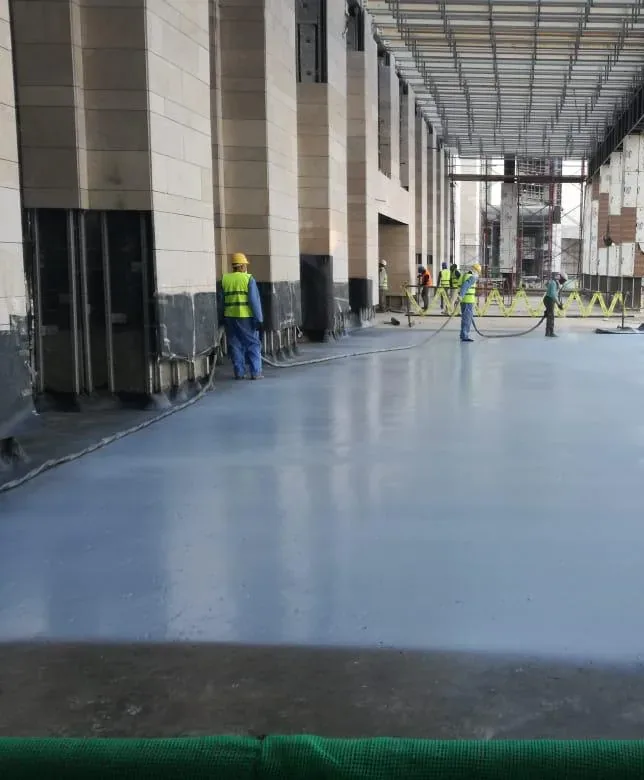
The Ministries District sits at the heart of Egypt’s New Administrative Capital. Around its squares lie gardens, planters and water features, built on top of buildings that must stay dry for decades.
According to the NAC project page, the Cairo contractor ETS applied Krypton spray polyurea and Impermax to about 20,000 m² of planters, landscape areas and water features in 2020–2021.
The logic was simple. Spray polyurea gels in about 4 seconds and builds a continuous skin over channels, upstands and corners. Meanwhile, cold-applied Impermax handles small, hard-to-reach edges and junctions where a spray gun is not practical.
Green Roof Waterproofing Step by Step
1. Open the concrete
First, prepare the slab mechanically by high-pressure sand or abrasion. Remove laitance, grind sharp edges and vacuum every bit of dust.
2. Check strength and moisture
Next, the NAC page gives the targets: pull-off of at least 1.4 N/mm² and moisture below 4%. Repair every crack before anything else.
3. Prime
Apply the primer and let it reach the right state for overcoating, as the TDS sets.
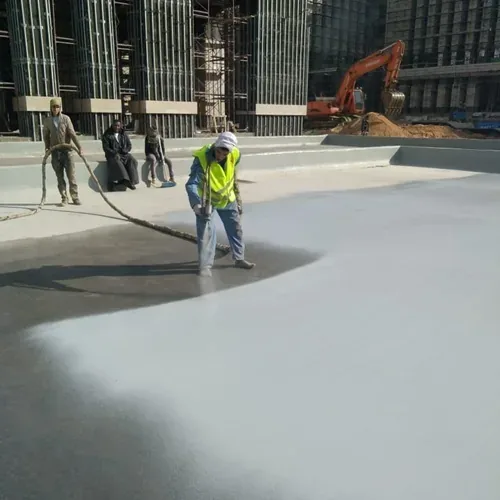
4. Spray the membrane
Then spray at about 60 °C on component A, 70 °C on B and 65 °C in the hose. Keep pressure between 135 and 170 bar. Avoid wind above 25 km/h.
5. Detail and test
After that, close drains, corners and pipes in the same film. Finally, flood-test before any soil or drainage layer goes down.
Common Mistakes on Planted Roofs
The gardened roofs page lists three general errors:
- Ignoring falls, outlets and ponding while focusing only on the membrane field.
- Bridging movement joints or penetrations without a designed detail.
- Closing the build-up before checking moisture, adhesion, thickness, cure and weather.
Equally important, a drip line in a photo is no proof of root resistance. As Krypton’s Oviedo note says, the certificate belongs to a specific product. So name the product and its root certificate in the same clause.
Egypt’s Desert Climate and Planted Roofs
Concrete in the Egyptian desert heats under strong sun and cools at night. As a result, the slab moves, and hairline cracks open and close. Therefore the membrane must stretch with them and stay bonded for decades. That is why elongation and full bond matter as much as root resistance.
Related Reading on Krypton Egypt
For soil-filled boxes, read planter box waterproofing. To compare roof membranes, see pure vs hybrid polyurea for roofs. For primers and moisture, check the surface preparation guide. Then use Krypton’s tool to choose your system by area, substrate and exposure.
FAQ
Do I need a root barrier with this membrane?
The Impermax Polyurea H ETA includes a root-penetration certificate based on EN 13948. Your designer still sets the full build-up.
Can tiles or soil go directly on it?
The TDS says the membrane can be covered by tiles, concrete or other materials. Follow the project’s drainage and protection design.
Conclusion: Certified Membrane, Continuous Details
Lasting green roof waterproofing needs a bonded, continuous, root-resistant membrane under wet soil. Impermax Polyurea H, with Polyurea Primer and Colodur, gives that route. Download the TDS, map your planters and drains, and ask Krypton Egypt for a technical quote.
No comment