

Most Egyptian buildings end in a flat concrete slab. Some stay empty, but many carry paving, plant, planters, cars and people. So concrete roof waterproofing must do more than stop rain. Also, it must stay continuous under finishes, cross moving joints, and survive a deck that heats at noon and cools at night.
For concrete roofs and decks that carry traffic or paving, Krypton’s podium decks application page lists a three-layer reference: Humidity Primer, then Impermax Polyurea H Flex, then a Colodur finish. Impermax Polyurea H Flex is a hot-sprayed, two-component polyurea membrane that cures fast into an elastic, crack-bridging film.
Why Concrete Roof Waterproofing Fails
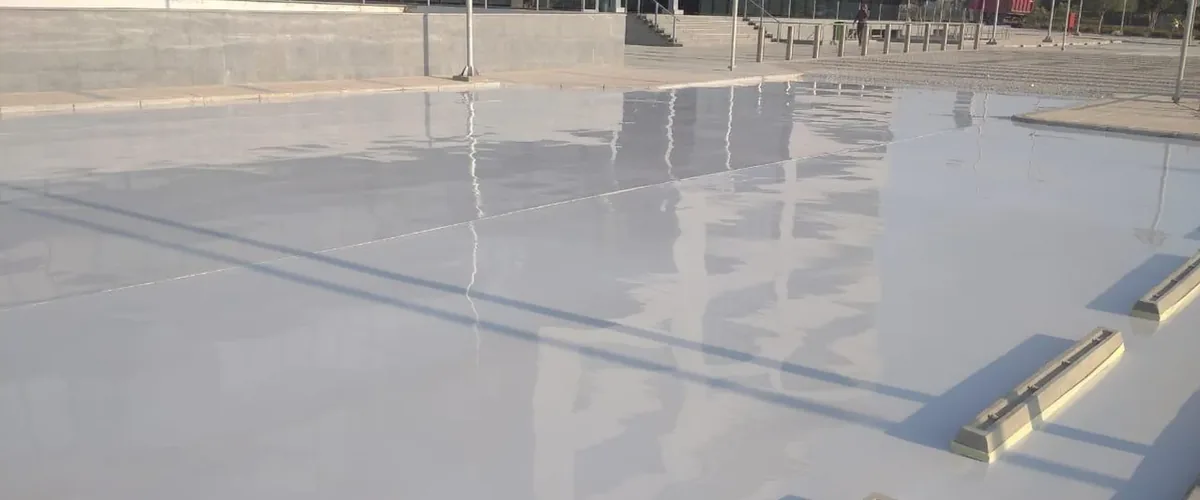
Krypton’s application page explains the problem. A deck carries finishes above a membrane that must remain continuous under paving, planters or screeds. Meanwhile, thermal movement, construction joints and drainage falls must work together with outlets and upstands.
The weak lines are always the same. They include expansion joints, kerbs, planters, penetrations, thresholds and façade interfaces. In fact, each needs a continuous, documented detail before the membrane route is fixed.
In New Cairo or Sheikh Zayed, the sun adds stress. A wide slab moves between noon and night. As a result, a stiff coating cracks at the upstand, exactly where water is heading.
The Layers of Concrete Roof Waterproofing
Humidity Primer
Concrete is rarely perfectly dry. According to its TDS, Humidity Primer is a water-based epoxy primer for supports with moisture between 4 and 8%. Besides, it helps reduce adhesion failures and blistering from water pressure below.
Impermax Polyurea H Flex
This is the waterproof layer. In addition, it is sprayed hot, usually at 2 kg/m² in one coat. Furthermore, it can carry an aluminium pigment for sun reflection.
Colodur
Aromatic polyurea changes colour in sunlight. Therefore a Colodur or Impertrans topcoat adds UV protection where the deck stays exposed.
Official TDS Data: Impermax Polyurea H Flex
| Property | Official value |
|---|---|
| Typical rate | 2 kg/m² |
| Elongation / tensile | 400% / 15 MPa |
| Tear strength / hardness | 43 N/mm / Shore 90A–40D |
| Gel time | 8–9 s at 25 °C |
| Rain-resistant / light foot traffic | 15 min / 1 h (25 °C, 50% RH) |
| Watertightness | Watertight at 60 kPa (EN 1928) |
| Crack bridging | A5 at 23 and −10 °C; B4.2 at −20 °C |
| Certification | ETA 21/0740, bridge-deck waterproofing |
The TDS also reports 90% of final properties after two days. You can verify the ETA in the EOTA database, and see the product on its kryptonchemical.com page.
Concrete Roof Waterproofing Step by Step
1. Survey the deck
First, record traffic, finishes, size and slab condition. Then map joints, kerbs, planters, outlets and upstands.
2. Prepare mechanically
Next, blast or abrade to open the pore. Also, the TDS asks for a flat, cohesive support with pull-off of at least 1.5 N/mm². Repair cracks, grind sharp edges and vacuum all dust.
3. Prime
Apply the primer that matches the slab’s moisture. Where moisture sits between 4 and 8%, Humidity Primer is the reference.
4. Spray hot
Then spray at about 70 °C on both components and 65 °C in the hose. Keep pressure between 135 and 170 bar. Avoid wind above 25 km/h, because it disturbs the gun’s mix.
5. Protect and finish
Finally, add Colodur where the film stays exposed. Then lay finishes without breaking continuity at thresholds and drains.
The Cairo Festival City Case
Cairo Festival City in New Cairo was waterproofed in several campaigns. According to the CFC project page, roofs took hot-spray Polyurea Rayston in 2018. Then 3,000 m² of roof received sprayed foam insulation in 2020. In 2021, structural joints were sealed with polyurea.
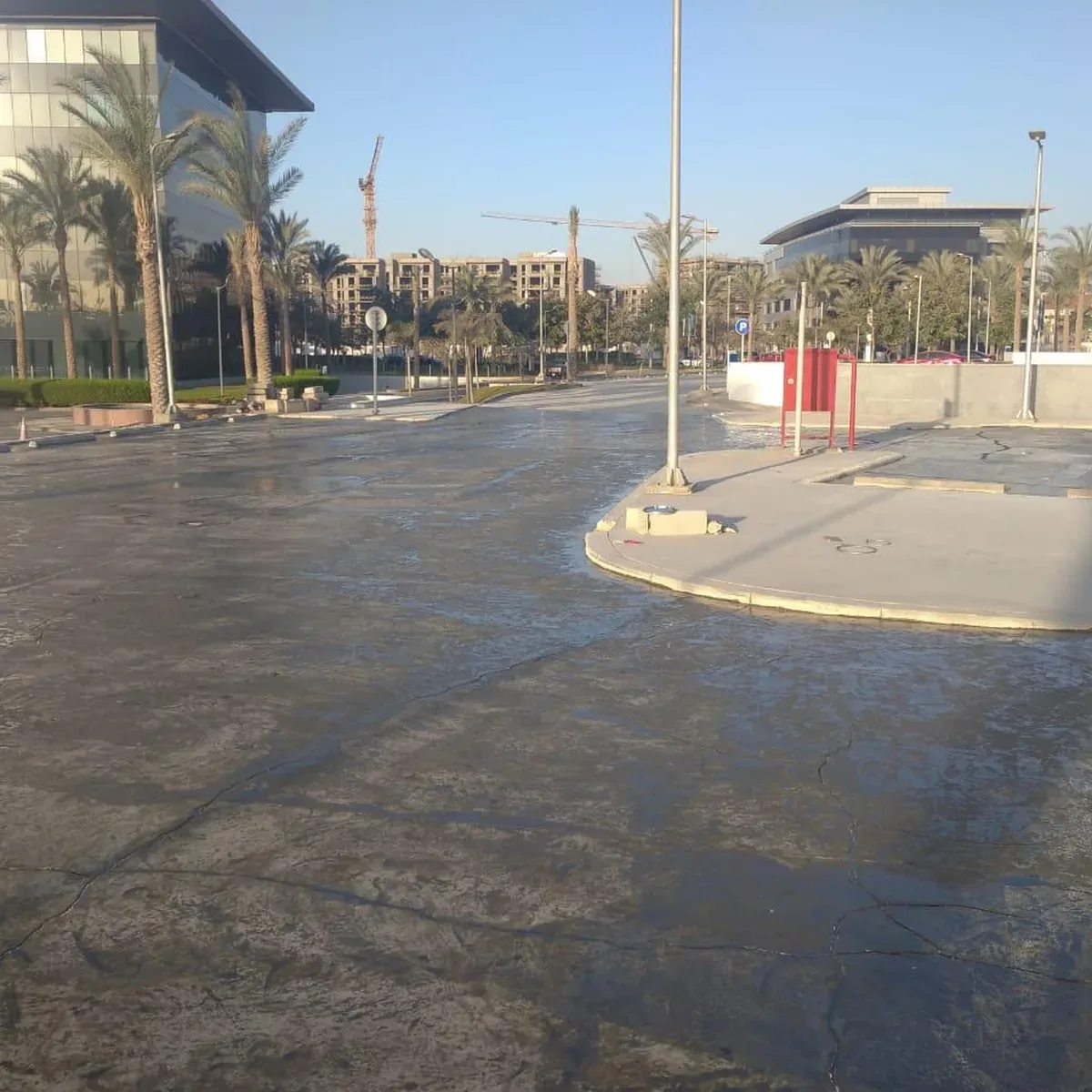
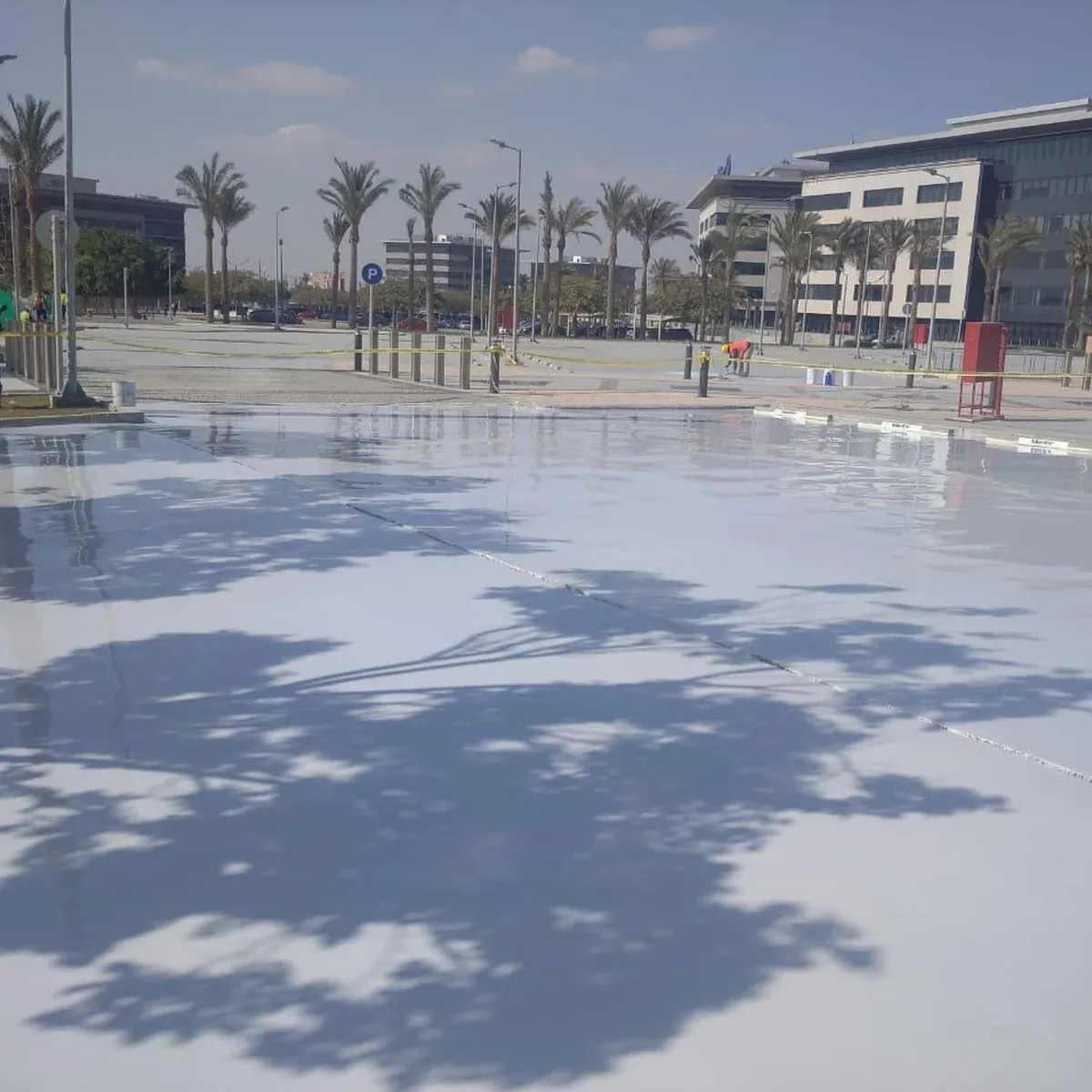
The podium was the hardest part. Before work began, the concrete was already cracked and holding water. So the team dried the deck and treated the cracks. Then a continuous light-grey membrane went across the bays, through the slot drains, and up the wall under the glass.
As Krypton puts it, a joint in the membrane over a crack in the concrete is “two leaks sharing an address”. In other words, the film must be one piece.
Common Mistakes on Concrete Decks
The podium page lists three:
- Treating the open field as the whole job, and omitting joints, planters, kerbs, outlets or façade upstands.
- Laying finishes without protecting continuity at thresholds, penetrations and drains.
- Closing the build-up before checking moisture, adhesion, thickness, cure and weather.
Equally, foam is not waterproofing. At CFC, the foam was insulation, and it needed a membrane over it.
Maintaining a Waterproofed Concrete Roof
A membrane still needs care. In fact, the H Flex TDS lists simple, regular tasks. First, remove leaves, grass, dirt and moss. Second, keep the storm water system working and the gratings in place. Third, check flashings, seams and retaining walls. Finally, reapply the decorative layer, such as Colodur or Impertrans, when traffic or weather wears it.
For stains, the TDS suggests Rayston solvent or isopropyl alcohol. However, strong acids are totally unsuitable. If a solvent damages the film, cut out the area and repair it with new membrane.
Related Reading on Krypton Egypt
To compare membrane chemistry, read pure vs hybrid polyurea for roofs. For decks with vehicles, see car park and bridge deck waterproofing. For primers and moisture, check the surface preparation guide. Then use Krypton’s tool to choose your system by area, substrate and exposure.
FAQ
Can I walk on the membrane the same day?
Yes. Besides, the TDS gives light pedestrian traffic after about 1 hour at 25 °C and 50% RH.
What if the slab is damp?
Measure first. For moisture between 4 and 8%, Humidity Primer is designed for that range.
Conclusion: One Film Under Every Finish
Reliable concrete roof waterproofing means one elastic film that stays continuous under paving, across joints and into drains. Impermax Polyurea H Flex, with Humidity Primer and Colodur, gives that route. Download the TDS, map your deck, and ask Krypton Egypt for a technical quote.
No comment