

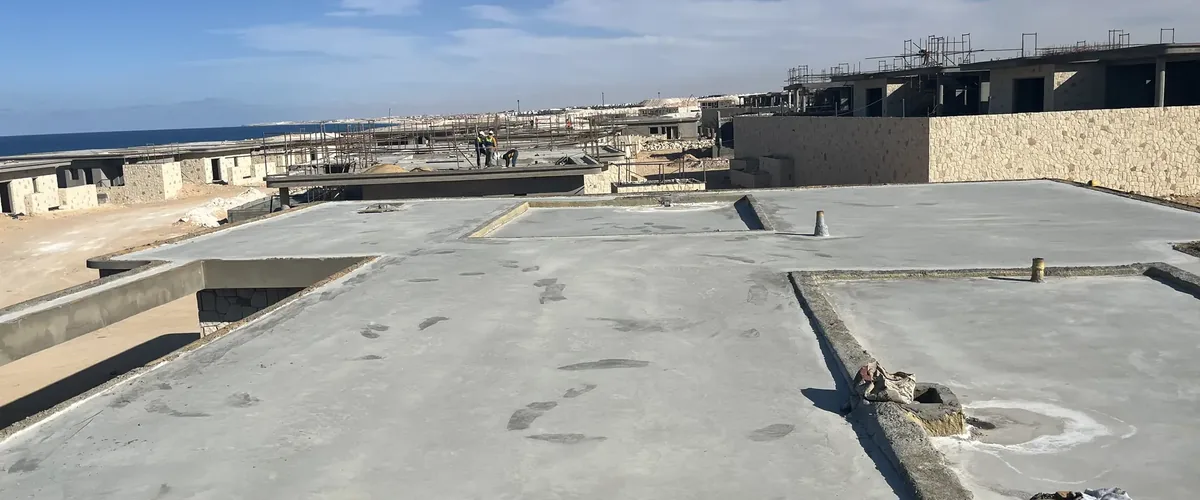
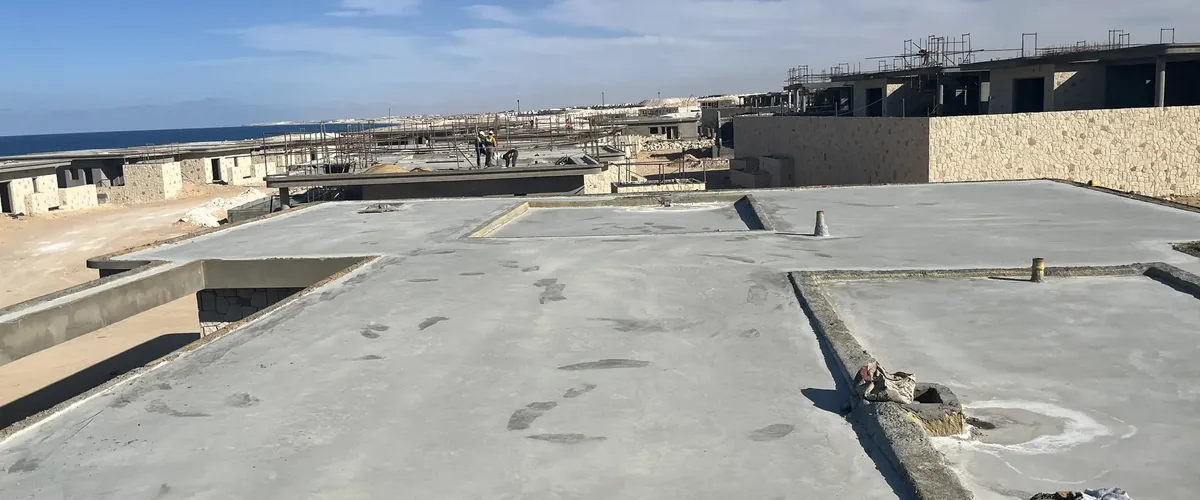
A flat concrete roof in Egypt works hard. It bakes at noon, cools at night and moves with every swing. That is why polyurethane roof waterproofing is so popular here. A liquid membrane follows the slab, wraps every upstand and leaves no seams for water to find. However, the result depends on the product, the primer and the details.
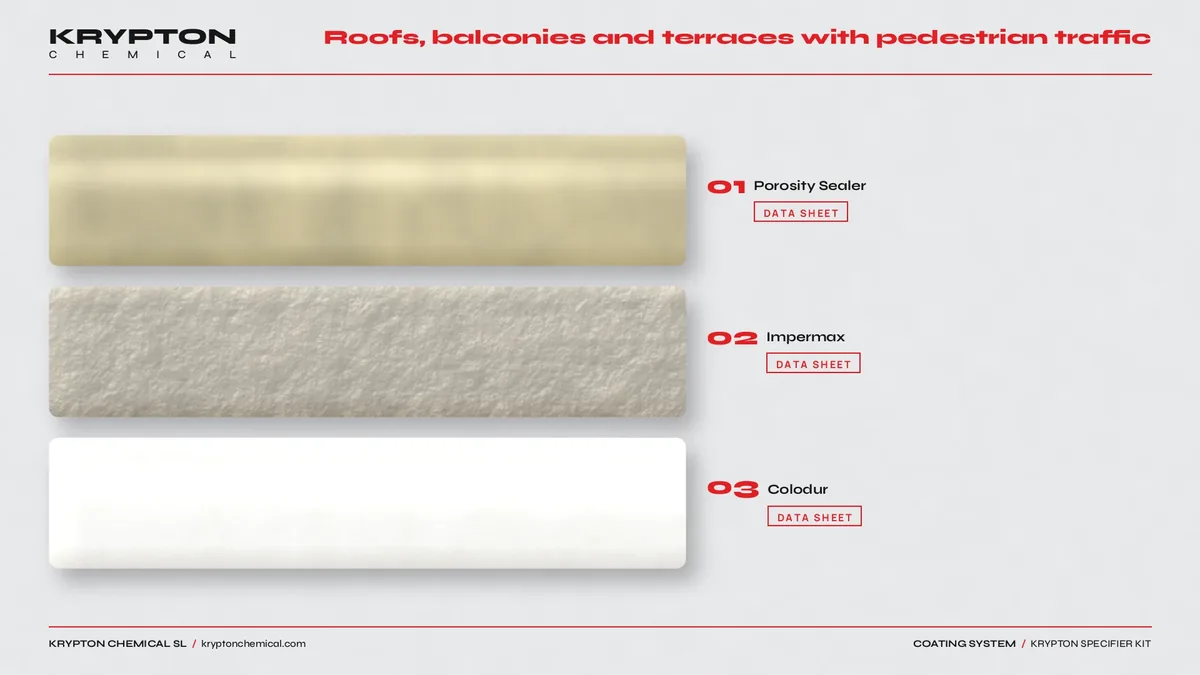
Krypton Chemical’s reference membrane for this use is Impermax, a one-component liquid polyurethane applied cold. On the official roofs, balconies and terraces page, the build-up is simple: concrete slab, Porosity Sealer primer, Impermax membrane and a Colodur topcoat. According to the TDS, Impermax cures into a continuous, elastic and fully adhered layer. It also withstands building movement.
Why Polyurethane Roof Waterproofing Suits Egyptian Roofs
Most roofs in Cairo, Alexandria and the new cities are concrete decks. They carry water tanks, AC units, pipes and parapets. Each of these is a detail where sheets need cutting and welding.
A liquid membrane avoids that problem. Instead of joining pieces, the crew rolls one continuous film. In addition, the Impermax TDS states that no mesh or felt is needed, except at specific points such as edges and corners. So the field goes down quickly, and the effort goes into the details.
Movement is the second reason. Egyptian slabs expand in the afternoon and contract at night. A brittle coating cracks at the parapet. Impermax, by contrast, lists a maximum elongation of 450–600% in its data sheet.
Impermax at a Glance: Official Figures
All values below come from the official Impermax technical data sheet.
| Property | Official value |
|---|---|
| Type | One-component aromatic polyurethane, cold-applied |
| Maximum elongation | 450–600% |
| Tensile strength | 2.5–4.3 MPa (EN-ISO 527-3) |
| Hardness | 65–70 Shore A |
| Adhesion | Concrete 2.0 MPa; ceramics 2.6 MPa; PU foam 1.4 MPa |
| External fire | BROOF(t1) for any roof slope (EN 13501-5) |
| Approvals | ETA 06/0263 with CE marking; BBA 11/4836 |
You can check the European assessment in the EOTA ETA database. The manufacturer’s Impermax product page shows the full range.
Notice the adhesion to ceramics. It means the membrane can also be used over sound old tiles after preparation, which is common on Egyptian rooftops.
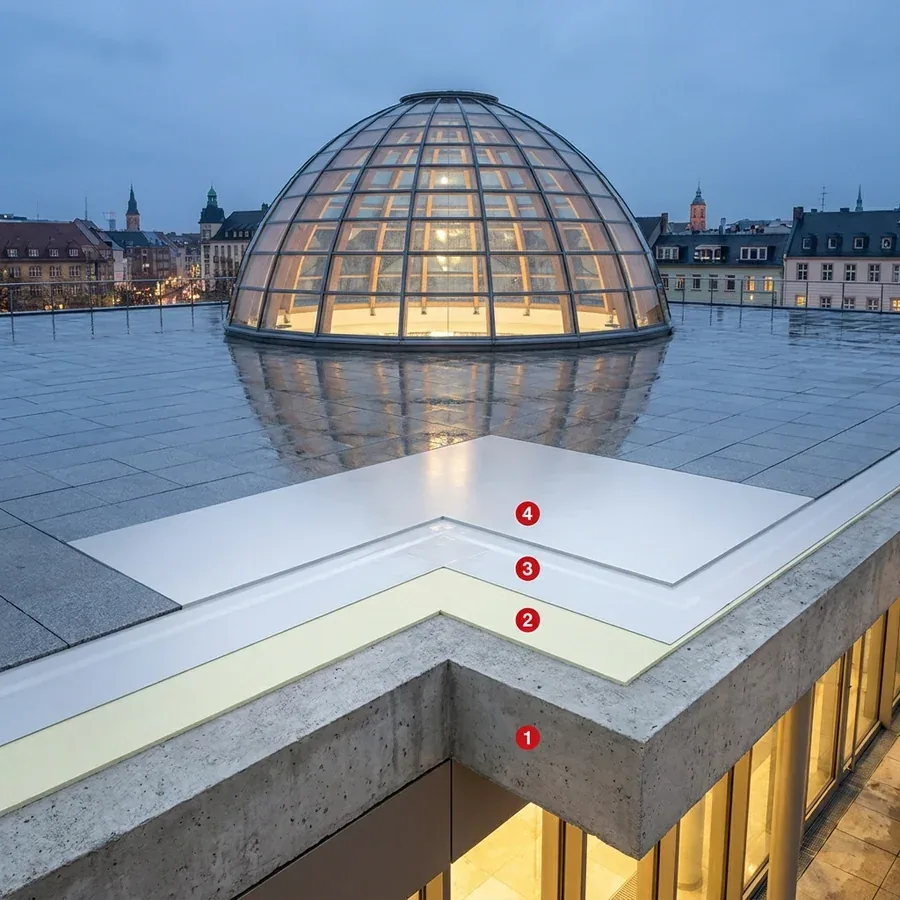
The Three-Layer System: Primer, Membrane, Topcoat
Porosity Sealer: the primer
First comes the primer. Porosity Sealer is a one-component, moisture-curing polyurethane resin. Its TDS describes it as a sealer and binder for concrete. As a result, the membrane bonds to a closed, stable surface.
Impermax: the waterproof layer
Next comes the membrane itself. The TDS recommends two coats of about 1 kg/m² each, in different colours. That way, a missed spot is easy to see. A spiked roller then removes bubbles right after spreading.
Colodur: sun protection
Finally, the topcoat. Impermax is aromatic, so its colour shifts in sunlight. The TDS says this does not affect its properties. Still, on a visible roof, Colodur adds an aliphatic finish that does not yellow, as its own data sheet states.
Polyurethane Roof Waterproofing Step by Step
The steps below follow the Impermax TDS. Always read the current version before work starts.
- Check the slab. It must be flat, cohesive (pull-off at least 1.5 N/mm²), clean and dry. Repair any cracks first.
- Treat the critical details. The TDS lists half pipes, wall junctions, parapets, skylights, expansion joints and drainage outlets.
- Prime with Porosity Sealer and let it cure.
- Stir Impermax slowly, then roll, brush, spread or spray it with airless equipment.
- Apply the second coat in a different colour at about 1 kg/m².
- Add the Colodur topcoat where colour stability matters.
Curing depends on the weather. For a 1 mm coat, the TDS gives 8–9 hours dry to touch at 24 °C and 52% RH. Usually, the roof is walkable after one or two days. It reaches about 90% of its final properties in three days. Final hardness takes 10 to 15 days, so wait before any water contact.
Working in Egyptian Heat
Summer is the real test. The TDS sets the substrate range at 5 °C to 40 °C. Above 45 °C, extra measures are needed, following the manufacturer’s instructions. On an exposed slab in Upper Egypt, that limit arrives early in the afternoon.
So start at dawn and stop before the deck gets too hot. Also watch humidity on the coast. The TDS warns that high humidity can cause blisters under the surface. In that case, Krypton names a humidity primer before application.
An Egyptian Case: The Ramla Compound
Krypton’s project record for Ramla, a coastal compound in Egypt, is a good example. There, the roofs were coated with Impermax in two passes. The crew could roll them between the other trades, without a spray rig on half-built villas. Meanwhile, the water tanks and planter basins took hot-spray Polyurea Rayston, because they stay wet.
That split is important. The Impermax TDS itself says that where permanent water contact is possible, Impermax Aqua 2K should be used instead. In other words, polyurethane roof waterproofing is for roofs that drain and dry, not for basins that stay full.
Related Guides from Krypton Egypt
For the full Impermax LY story, read our article on Impermax LY liquid polyurethane. To compare chemistries, see polyurea vs polyurethane waterproofing. And if you are weighing spray systems, our guide to pure vs hybrid polyurea roofs helps. Still unsure? Use Krypton’s tool to choose your waterproofing system.
Polyurethane Roof Waterproofing FAQ
Can Impermax go over old tiles?
Yes, if the tiles are sound and clean. The TDS gives 2.6 MPa adhesion on ceramics. Still, loose tiles must be fixed first.
How many coats does a roof need?
The TDS recommends two coats of about 1 kg/m² each. It also warns against less than 1 kg/m² per coat on horizontal areas.
Can it line a water tank?
No. For permanent water contact, the TDS names Impermax Aqua 2K instead.
Conclusion: A Seamless Roof Starts with the Details
Good polyurethane roof waterproofing is more than a bucket and a roller. It needs a sound slab, a primer, two measured coats and a UV topcoat where the sun hits hard. Impermax gives Egyptian roofs that system, backed by ETA 06/0263 and BBA 11/4836. Download the TDS, plan around the heat, and contact Krypton Egypt for a technical quote.
No comment