

A hotel pool in Hurghada never really rests. It stays full for months, the water is warm and treated, and guests walk barefoot along its edge every day. That is why a polyurea pool coating has become a serious option for owners tired of leaking tiles and open joints. In this guide, we explain the layers, the details that decide success, and a real Red Sea project. Krypton’s engineering page on swimming pool waterproofing systems is the reference behind it.
Why choose a polyurea pool coating?
Most pool leaks start at the same places. Steps, skimmers, lighting niches and the joint between floor and wall all move a little and stay wet. A jointed lining, such as tiles over a weak membrane, tends to open there first.
Sprayed polyurea works differently. Polyurea Rayston is a two-component pure polyurea that only hot spray equipment can apply. Its datasheet gives a gel time of 4 seconds at 25 ºC. As a result, the film forms on vertical walls without running, and it wraps corners and outlets in one continuous skin.
The membrane is also elastic. The Polyurea Rayston TDS lists a maximum elongation of 324% and a tensile strength of 16.2 MPa. Its tear strength is 69 N/mm. In addition, it stays watertight at 5 bar, equal to a 50 m water column, in the EN 12390-8 test. That is far beyond the water depth of any pool.
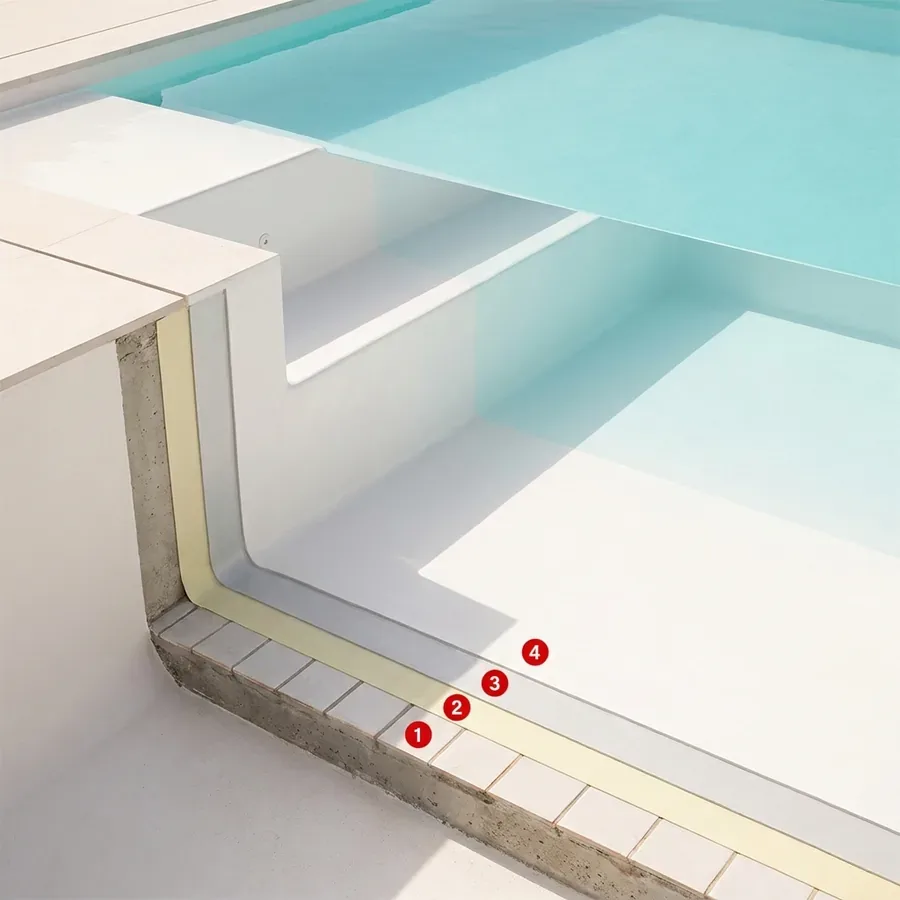
The polyurea pool coating system, layer by layer
Krypton’s pool application page names three reference products for a concrete shell. Each one has a different job, so do not skip any of them.
1. Primer: Rayston Epoxy 100
Its TDS describes Rayston Epoxy 100 as a two-component, universal epoxy primer for completely dry surfaces. It seals the pores of the concrete and gives the membrane a sound base to bond to.
2. Membrane: Polyurea Rayston
The waterproofing itself comes from Polyurea Rayston. Its TDS gives a usual rate of 1.5 to 2.0 kg/m², or a film of about 1.5 to 2 mm. Moreover, the product carries CE marking to EN 1504-2 and European Technical Assessment ETA 16/0148. You can read more about ETA documents on the European Organisation for Technical Assessment (EOTA) website.
3. Finish: Paintchlore 2K
Polyurea Rayston is based on an aromatic isocyanate. Therefore, its colour changes under sunlight, although its TDS states that this does not affect the mechanical properties. On a pool, appearance matters, so the system needs a finish. Paintchlore 2K is a high-gloss, two-component aliphatic PU topcoat. Its TDS describes it as especially suited for coating and protecting swimming pools.
Paintchlore 2K: the finish of a polyurea pool coating
The finish is simple to apply, but its datasheet sets clear limits. Follow them, because a pool filled too early is the most common way to spoil a good membrane.
- Mixing: 4 parts resin to 1 part hardener by volume.
- Pot life: 5 hours at 20 ºC.
- Thickness: more than 100 microns dry film; 250 g/m² in two coats gives 117 µm.
- Colours: white or blue (similar to RAL 5015).
- Water resistance: after 7 days minimum.
- Suitable pools: polyurea, concrete and polyester resin.
In short, plan at least a week between the last finish coat and filling. Krypton’s note on Paintchlore 2K over Polyurea Rayston on a tiled pool shows the same build-up on an existing ceramic shell.
Surface preparation before a polyurea pool coating
A pool membrane is only as good as the concrete under it. The Polyurea Rayston TDS sets these support requirements:
- a flat, compact and cohesive support, with a pull-off of at least 1.4 N/mm²;
- cracks repaired before spraying;
- support temperature between 10 ºC and 40 ºC;
- support moisture below 4%.
Open the concrete mechanically, for example by high-pressure sand or abrasion, then vacuum the dust. For a fuller checklist, see our guide to polyurea surface preparation and primers.
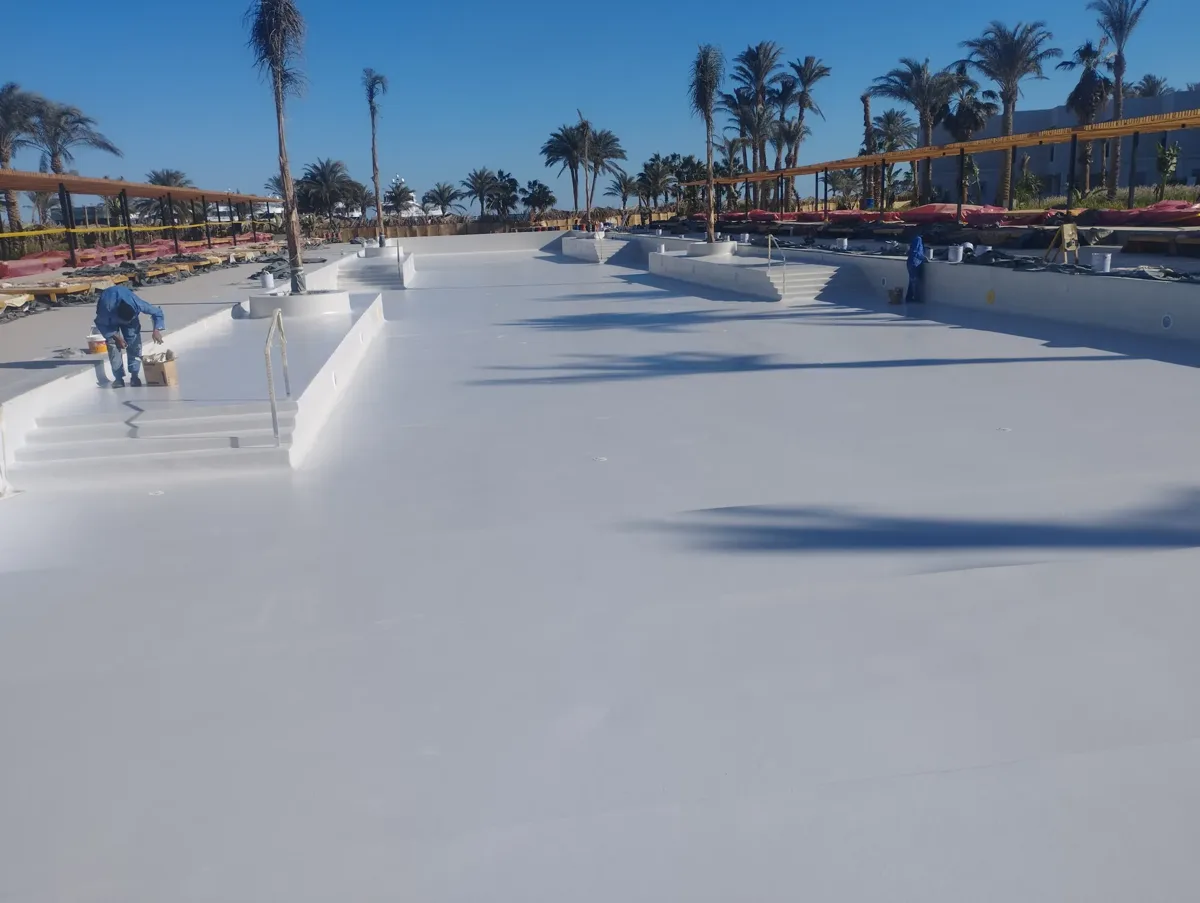
Polyurea pool coating in Egypt: Sindbad Hotel, Hurghada
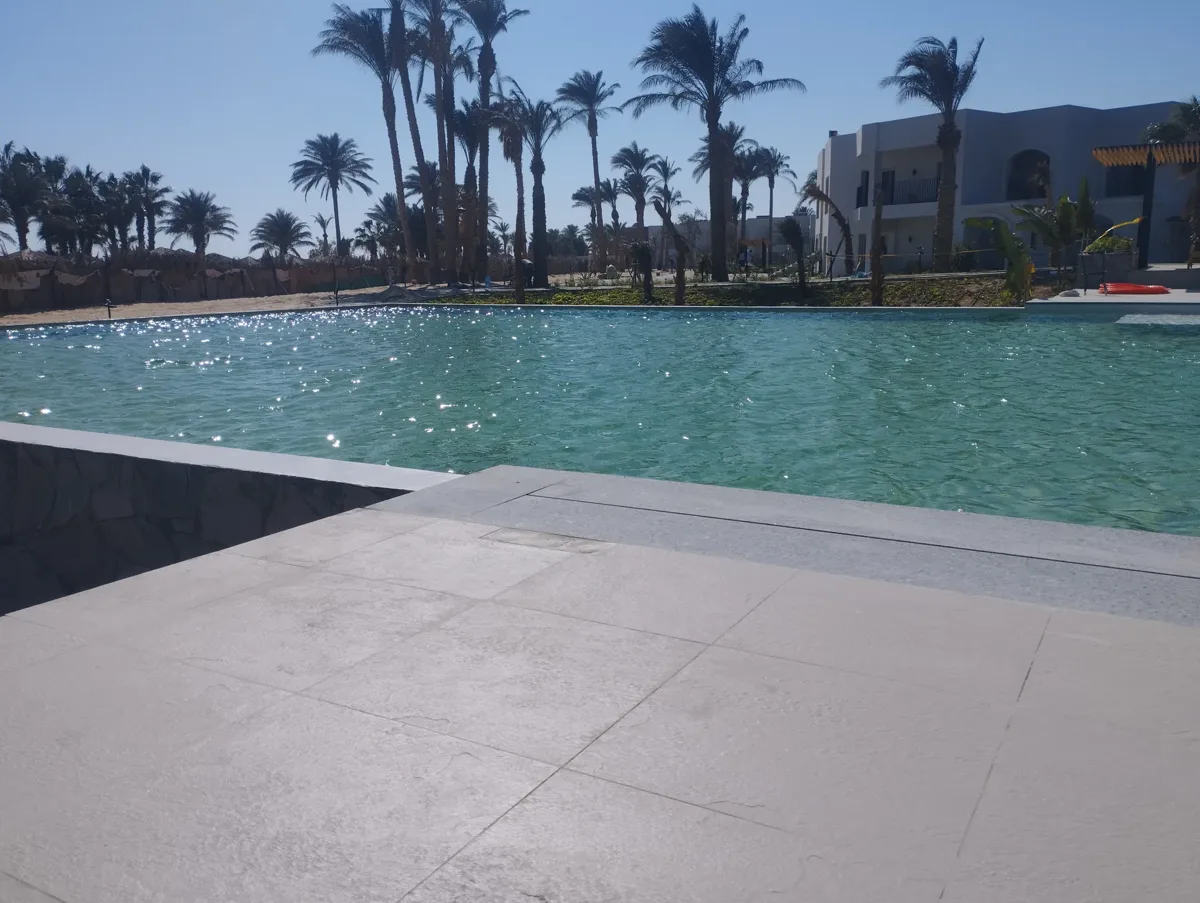
In 2023, the pools at Sindbad Hotel on the Red Sea received a pure Krypton polyurea lining. The area was 2,500 m², and the applicator was ETS. You can read the details on the Sindbad Hotel pool waterproofing project page.
The challenge was typical of resort pools. Steps, skimmers and floor-to-wall joints are where linings usually fail. A sprayed film closes those details in one pass, so there is no lap to peel later.
Details that decide a polyurea pool coating
Krypton’s pool guidance lists several mistakes that appear again and again. Avoid them, and the membrane will do its job.
- Ignoring water treatment: check the chlorination and treatment chemistry before choosing the finish.
- Treating only the floor: walls, steps, gutters, skimmers, niches and joint ends are part of the same detail.
- Closing too fast: check moisture, adhesion, thickness and pinholes before the finish goes on.
Also, map every penetration before work starts. Pipe entries and lights should sit inside the sprayed film, not in a ring of mastic added later.
Maintenance after a polyurea pool coating
The work does not end when the pool is full. If appearance matters, the Polyurea Rayston TDS recommends regular cleaning with water, with a mild detergent where needed. It also warns that strong acids are totally inadequate and that some solvents may damage the membrane.
If part of the membrane gets damaged, the repair route in the TDS is clear. Cut out the affected area and spray new Polyurea Rayston. For that reason, keep a record of areas and thicknesses from the day of application. It makes any later repair faster and shortens the time the pool stays closed.
Frequently asked questions
Can a polyurea pool coating go over old tiles?
Yes, in suitable cases. Krypton documents a private pool finished with Polyurea Rayston and Paintchlore 2K over its existing ceramic tiles. Even so, test adhesion on site first.
Does the membrane need a topcoat in a pool?
Polyurea Rayston keeps its mechanical properties when its colour changes. However, a pool is a visible surface, so Paintchlore 2K is the finish Krypton names for this use.
How long before you can fill the pool?
The Paintchlore 2K TDS gives water resistance after 7 days minimum. Use that as the earliest filling date.
Is this the same system as a drinking water tank?
No. Tanks follow different rules and approvals, as our article on polyurea water tank coating explains.
For product data, see the Polyurea Rayston product page by Krypton Chemical. For a site visit or a quotation in Egypt, contact the Krypton Egypt team.
No comment