

A corrugated metal roof in Egypt, over a hangar, a warehouse or a villa, has two jobs, and it often fails both. It must keep the heat out of the rooms below, and it must keep rain and condensation away from every lap and screw. This guide covers metal roof waterproofing and insulation with three Krypton routes: spray foam with a protective finish, a cold liquid polyurethane membrane and a hot-spray aluminium polyurea. It builds on Krypton’s engineering guide to metal roofs.
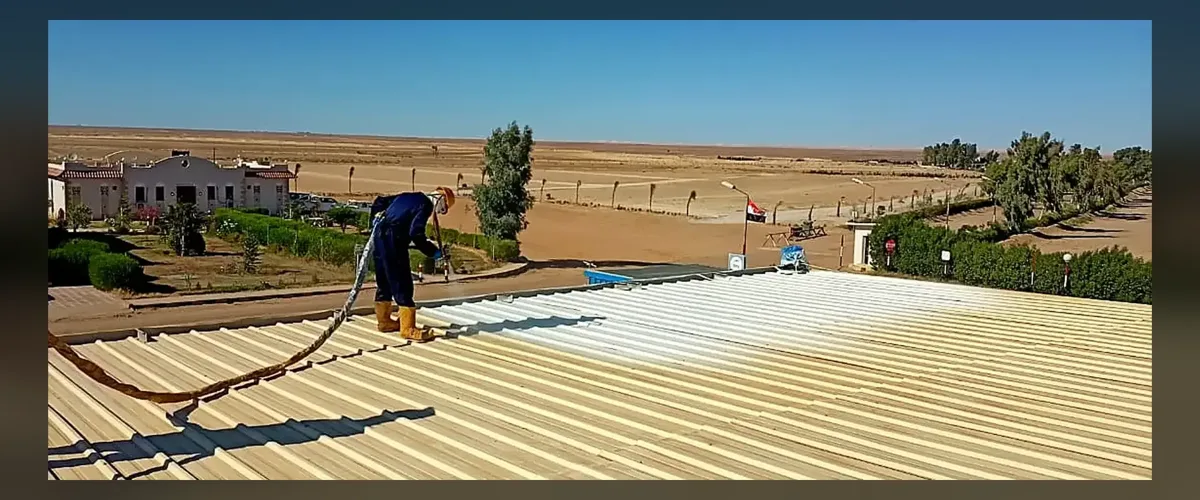
Why metal roof waterproofing fails
Corrugated sheets move, because they heat up fast and cool fast. As a result, every lap and fixing becomes a potential leak. A thin paint film on rusted metal will not last either.
Krypton’s metal roof page lists the classic mistakes. First, crews ignore falls, outlets and ponding and focus only on the membrane field. Second, they bridge movement joints or penetrations without a designed detail. Third, they close the build-up before checking moisture, adhesion, thickness, cure and weather limits.
Route 1: spray foam plus a protective finish
First of all, when heat is the main problem, insulation comes first. Krypton’s guide on insulating metal roofs with spray polyurethane foam describes a simple sequence. Prepare the sheets, spray a continuous foam layer, then protect the foam from the sun.
That last step is not optional. According to the guide, foam left bare will degrade in ultraviolet light. Therefore, a finish must cover it completely, including edges and upstands.
The Egyptian case: Khalda Petroleum
In 2021, Khalda Petroleum insulated villa and building roofs in the Abu Gharadig concession. The area was 15,000 m², with Rayston spray polyurethane foam and an acrylic finish. ETS carried out the work. Notably, Krypton does not name a single foam density for this job, so we do not quote one.
The same programme sealed tiled roofs with spray polyurea. In other words, each system went where it belonged: foam to insulate metal, polyurea to waterproof other exposures.
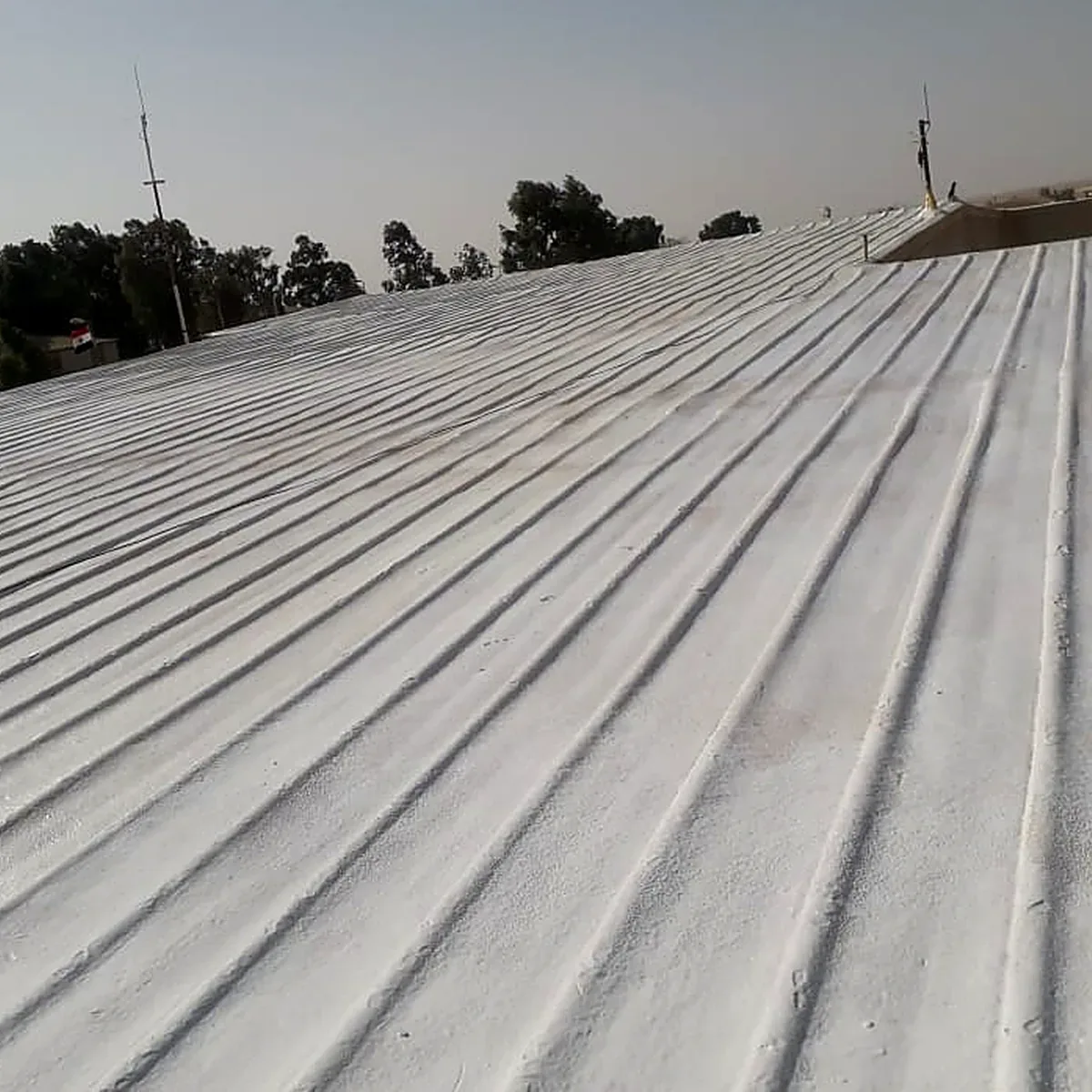
Route 2: cold liquid membrane for metal roof waterproofing
Many metal roofs need waterproofing without a spray rig. Here, Krypton’s metal roof page names Impermax ST among its reference products. The IMPERMAX ST TDS describes a single-component liquid membrane that cures into a cold-applied polyurethane elastomer.
In short, the TDS gives these key points:
- Substrates: the list includes steel, zinc and aluminium.
- Mechanical: 421% maximum elongation and 3.4 MPa tensile stress.
- Adhesion: 2.0 MPa on concrete, 2.6 MPa on ceramics and 1.4 MPa on polyurethane foam.
- Fire: BROOF(t1) for any roof slope and BROOF(t4), under EN 13501-5.
- Approval: ETA Nº 06/0263, with 10- and 25-year CE marking.
- Application: substrate temperature between 5 °C and 40 °C.
However, one point needs honesty. The TDS states that a colour change is expected, due to its aromatic polyurethane composition. Even so, it adds that this discolouration does not affect its properties.
Route 3: hot-spray aluminium polyurea
On the other hand, speed matters on large roofs. Impermax Polyurea H Flex Alum is the aluminium version of Impermax Polyurea H Flex. Indeed, its TDS states that both share the same mechanical properties and certificates. Krypton also shows it encapsulating Rayston foam, so one roof gets both insulation and waterproofing.
Crucially, the TDS explains why the Alum grade suits sun-exposed roofs. Its special colour does not turn yellow in sunlight, so it needs no aliphatic topcoat. It also has improved electrical conductivity, with an antistatic effect. Other values from the TDS:
- Elongation and tensile: 400% and 14 MPa.
- Hardness: 90A/40D.
- Gel time: 8–9 s at 25 °C.
- Adhesion: 3.6 MPa on steel with PU primer, and 5.6 MPa on concrete with EP 100 primer.
- Approval: ETA Nº 21/0740 (EAD 030675-00-0107), CE marking.
Read more in Krypton’s note on Impermax Polyurea H Flex Alum. You can also check ETA holders through the European Organisation for Technical Assessment (EOTA).
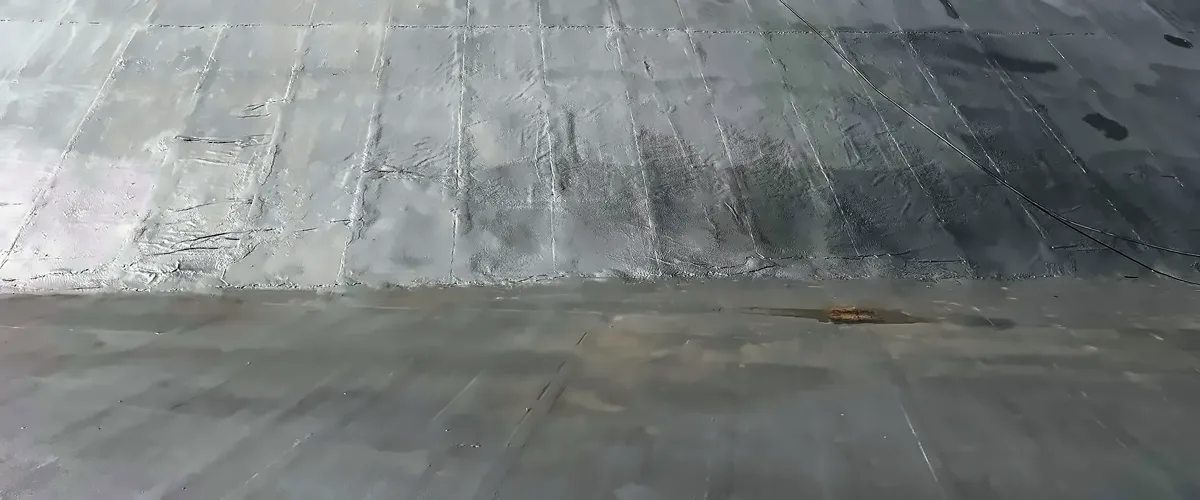
Primer for galvanised sheet
Before any membrane, galvanised and aluminium sheets need a primer that bonds to non-ferrous metal. Krypton’s datasheet for its ProLine PU primer describes a single-component, moisture-curing polyurethane primer and sealer with aluminium and MIO pigments. Specifically, it lists use as a sealer coat for non-ferrous metal and galvanised surfaces. Moreover, it allows application down to -18 °C and up to 99% relative humidity.
Metal roof waterproofing details: laps, screws and gutters
On a metal roof, the field of the sheet rarely leaks. Instead, water finds the laps, fixings, gutters and upstands. For this reason, Krypton’s metal roof page asks you to map joints, edges, penetrations, drains, upstands and repair zones before choosing the route.
In practice, treat each detail before the main coat. For example, the IMPERMAX ST TDS notes that no reinforcement is usually required, except at critical points. In addition, it lists thermal resistance as stable up to 140 °C, which matters on a hot roof.
Which metal roof waterproofing route fits your roof?
- Hot roof, comfort problem: spray foam with a full protective finish.
- Leaks at laps and screws, no spray rig: a cold liquid PU such as Impermax ST.
- Large area, fast return to service: hot-spray H Flex Alum.
To compare pure and hybrid polyurea on roofs, read our guide to polyurea roof waterproofing. For the cold versus hot decision, see cold-applied vs hot-spray polyurea.
Frequently asked questions
Can liquid membranes go straight onto metal sheets?
The IMPERMAX ST TDS lists steel, zinc and aluminium among its substrates. Even so, the support must be clean, dry and sound, and critical details need treatment first.
Does foam alone waterproof a metal roof?
No. In fact, Krypton’s guide says foam must not stay exposed. Instead, a protective finish is the UV shield and the first weather skin.
For full product data, see IMPERMAX ST on Krypton Chemical.
No comment