

Few structures work harder and get less attention than a sewer manhole. Wastewater, splash and gas attack the concrete every day, yet nobody looks inside until a ring joint leaks or the benching crumbles. A proper manhole coating stops that slow damage with one continuous lining. This guide explains how Krypton approaches manholes and wastewater tanks with pure polyurea, based on its engineering guide for manhole waterproofing.

What attacks a manhole?
Krypton’s manhole page lists the threats clearly. First, shafts see wastewater immersion and splash. Second, hydrogen sulphide (H2S) vapour attacks the concrete. Third, preparation and inspection happen in confined spaces.
The concrete adds risk too. Rings and chambers bring pores, leaky joints and cracks. Furthermore, benchings, channel inverts, ring joints, pipe entries, cover frames and ladders all need a continuous detail. As a result, a generic paint rarely survives.
Why pure polyurea for manhole coating?
A sprayed polyurea forms a seamless membrane in seconds. Therefore, it can follow the curves of a shaft and wrap pipe entries without laps. Krypton’s manhole page names two typical reference products: Humidity Primer and Krypton ProLine CH55.
The ProLine CH55 TDS explains the choice. It lists the protection of hydraulic infrastructures from chemical waste, with high resistance to H2S. It also lists the rehabilitation of leaking concrete tanks or substrates subject to movement. In addition, its gel time is 6 s at 25 °C, so the film stays on vertical walls.
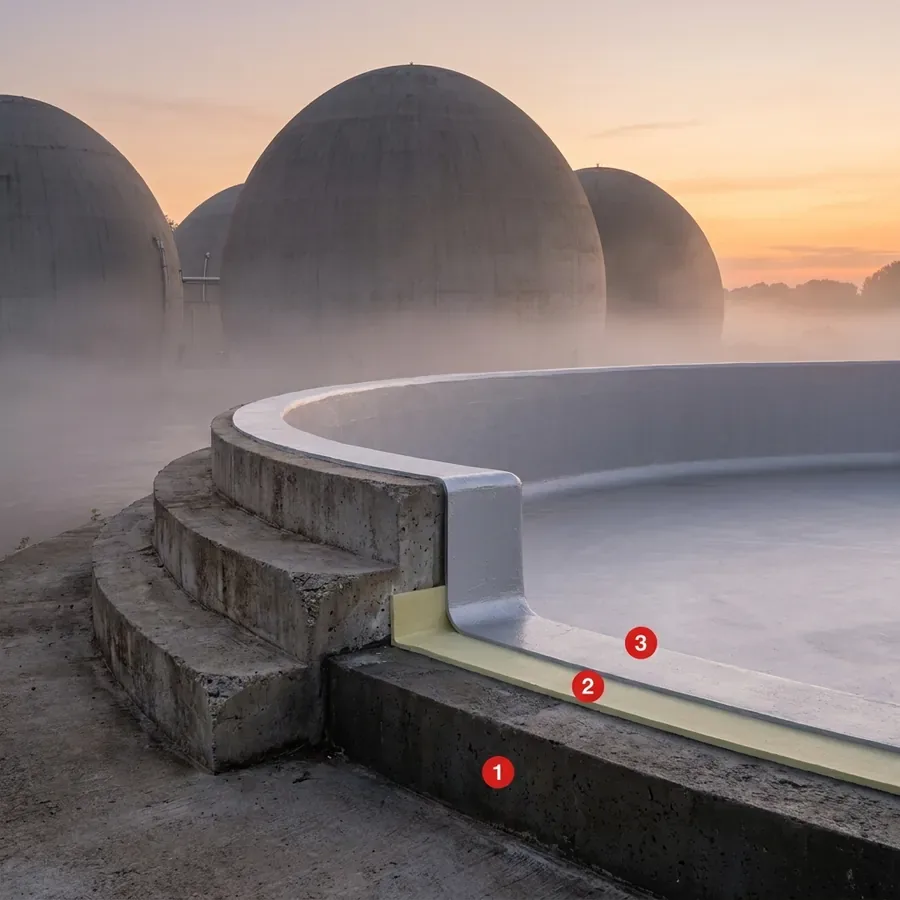
The manhole coating system, layer by layer
1. Humidity Primer on damp concrete
Manholes are rarely dry. The Humidity Primer TDS describes a two-component, water-based epoxy primer that is totally compatible with moist supports. According to the TDS, it helps to minimise adhesion failures and to avoid blistering from water pressure below.
The TDS also sets limits. It recommends the primer for supports with a moisture content between 4% and 8%. However, it is not useful when moisture has a phreatic origin with pressures greater than 1.5 N/mm². So, measure first and diagnose the source of the water.
2. Krypton ProLine CH55 membrane
Next comes the pure polyurea membrane. Its TDS lists these values:
- Elongation: 450% maximum.
- Tensile strength: 25 MPa.
- Adhesion to concrete: 2.5 MPa.
- Impact resistance: 24.5 N·m, Class III.
- Certification: CE marking to EN 1504-2, certificate 0370-CPR-2247.
The CE mark matters for public tenders. The EN 1504-2 standard covers surface protection systems for concrete, and CE marking falls under the EU Construction Products Regulation.
Gas, abrasion and flow in the invert
A manhole is not only wet. It also holds gas and carries grit. So the membrane must block both. The ProLine CH55 TDS lists very low permeability to gases, radon, methane and carbon dioxide. It gives a methane gas permeation coefficient of 140 Ncm³·mm/m²·day·bar (DIN 53380/ISO 15105-1).
Grit in the flow wears the invert. Here the TDS lists very good abrasion resistance, with a Taber loss of 13 mg (CS17, 1000 cycles, 1 kg). It also lists a low friction coefficient. In short, the lining helps the flow and resists the wear at the same time.
Manhole coating details that decide success
Most failures start at the edges, not in the middle of a wall. For this reason, map every detail before spraying:
- Ring joints: treat them as moving joints and carry the membrane across.
- Pipe entries: wrap the lining into the pipe so water cannot track behind it.
- Benchings and inverts: these take the flow, so they need full thickness.
- Cover frames and ladders: terminate the lining neatly around each fixing.
Finally, check adhesion, thickness, continuity and cure before closing the shaft. Krypton’s guide warns against closing the lining before these checks in confined-space conditions.
Beyond manholes: wastewater tanks and digesters
The same logic scales up to treatment plants. For example, the Polyurea Rayston TDS lists sewage and wastewater treatment structures among its applications. Krypton’s page on digesters and WWTPs names Rayston Epoxy 100 and Polyurea Rayston as reference products.
Biogas adds another demand. The Rayston Spray D50 TDS lists waste water treatment plants and biogas digesters among its uses. It also describes very low permeability to radon, methane and carbon dioxide gas. In Ibiza, Krypton documented a wastewater plant lined with Rayston Spray D50, with Rayston Epoxy 100 as primer and grey Colodur as sealer.
An Egyptian reference: Chloride Egypt
In Egypt, Krypton lists a related industrial job. In 2020, the drainage channels at Chloride Egypt were lined with pure polyurea, Polyurea Rayston, applied by Nile City. A drain is almost all detail, with corners and outlets. Similarly, a manhole is a vertical version of the same problem.
Common manhole coating mistakes
- Ignoring the chemistry: record the wastewater chemistry and H2S exposure first.
- Using the wrong primer: damp concrete needs a primer designed for moisture.
- Skipping details: joints, entries and frames cause most leaks.
- No test area: approve a representative area before the full job.
Concrete preparation follows the same rules as below-grade work. Read our guides on polyurea foundation waterproofing and surface preparation and primers. For full product data, see Krypton ProLine CH55 on Krypton Chemical.
Frequently asked questions
How long does a manhole coating take to cure?
ProLine CH55 gels in 6 s at 25 °C, according to its TDS. However, follow the TDS for return-to-service times on each project.
Can I coat a wet manhole?
Humidity Primer suits supports with 4–8% moisture. It is not for active phreatic pressure above 1.5 N/mm², so stop leaks first.
No comment