

Most polyurea failures do not come from the polyurea. Instead, they come from what is underneath it. Blisters, delamination and pinholes usually trace back to a poorly prepared substrate, the wrong primer, or moisture nobody measured. Getting polyurea surface preparation right is at least half of the job. This guide turns Krypton’s technical guidance into practical steps, from choosing a polyurea primer for rigid substrates to checking site conditions before spraying.
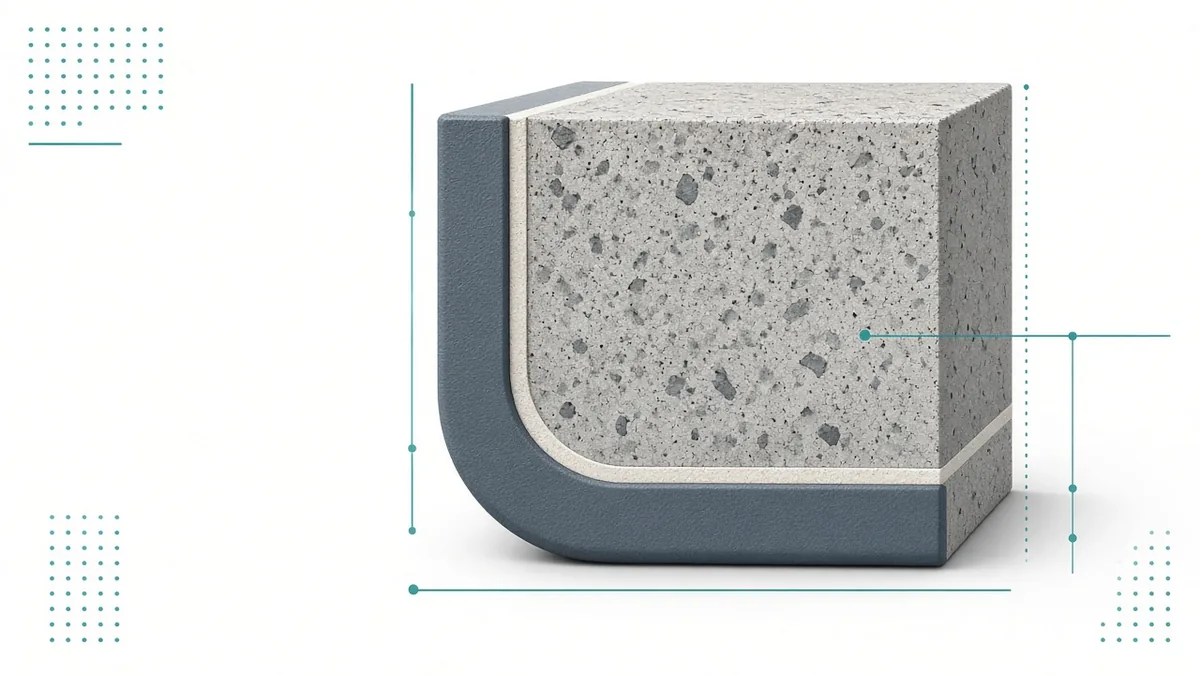
Why polyurea fails when you skip preparation
The Impermax Polyurea H Supreme application guide lists the classic problems and their causes:
- Membrane does not cure: check the A/B mix ratio and machine pressure.
- Bubbles in the membrane: usually a missing primer.
- Colour change: UV exposure. Choose dark grey or red, or add a topcoat.
In other words, you solve two of those three problems before you ever pull the trigger.
Step 1: Assess the concrete
Before any primer goes on, the concrete must be strong enough to hold the membrane. The rigid Polyurea Primer TDS calls for:
- surface cohesion of at least 1.5 MPa;
- compressive strength of at least 25 MPa;
- moisture below 4%;
- a 21-day wait on fresh concrete.
The H Supreme guide, however, asks for a pull-off of at least 1.4 N/mm². So follow the figure on the data sheet of the product you are actually using.
Mechanical preparation
- Concrete: shot-blast or scarify to remove laitance and open the pores, then vacuum and prime.
- Metal: sand, then apply a suitable PU primer.
- Existing surfaces: remove weak layers, oil and loose paint before priming.
Step 2: Choose the right polyurea primer
Rigid substrates: Polyurea Primer
This is a rigid polyurethane primer for concrete and other hard substrates. According to its TDS:
- mix ratio of 100:10 and coverage of 300–400 g/m²;
- stir each component at low speed for 2 minutes;
- pot life of 60 minutes;
- touch-dry in 25 minutes at 25 °C, or 45 minutes at 10 °C;
- Shore 70D, adhesion above 5 N/mm² (EN 13892-8), stable up to 80 °C;
- substrate at 10–25 °C, air at 10–30 °C and RH at or below 60%.
Because it is aromatic, it may yellow, but without any loss of properties.
A hot-climate note: the 25 °C substrate limit is far below summer roof temperatures in Egypt or the Gulf. Therefore, prime early in the morning or in shade, and measure substrate temperature with a gauge rather than guessing.
Flexible substrates: Polyurea Primer Flex
When spraying over existing PVC, EPDM or bituminous felt, use Polyurea Primer Flex for flexible substrates. Its TDS values include:
- coverage of 200–400 g/m²;
- touch-dry in 35 minutes at 25 °C;
- 540% elongation, 19 MPa tensile strength and Shore 75A.
However, it is not suitable for polyolefins.
Damp concrete: humidity primers
For residual moisture in concrete, Krypton’s 2026 catalogue lists Humidity Primer and Humidity Primer LV. These are epoxy primers for residual moisture, not for standing water. Primer Epoxy 100, by contrast, is a different epoxy primer, so do not swap the names.
Step 3: Moisture and dew point
As Krypton’s note on dew point, residual moisture and overcoat intervals puts it, a weather app is not an application window. Only measured site values are. If a crew ignores the dew point, the coat can carry blisters into the next layer. Reference figures:
- Rayston Spray D50 requires the substrate to be at least 3 °C above the dew point.
- Most hot-spray polyureas also require substrate moisture below 4%.
- The H Supreme guide requires air RH below 70% and warns that wind above 25 km/h causes spray problems.
In coastal cities such as Alexandria or Port Said, morning humidity runs high, so measure the dew point before starting.
Step 4: Timing between primer and membrane
From the Impermax Polyurea H Supreme application guide:
- Let an epoxy primer cure for about 8 hours before spraying.
- Then apply the second membrane coat within 2 hours of the first.
- Machine settings: component A at 70 °C, component B at 75 °C, hose at 70 °C, 150 bar.
Pre-spray checklist
- Pull-off test recorded and within the TDS value.
- Concrete moisture measured with a meter.
- Substrate temperature and dew point measured.
- Primer applied and cured for the stated time.
- Wind below 25 km/h during spraying.
- A trained crew. Krypton Chemical runs applicator training and certification.
Because the EN 1504-2 concrete-protection standard sits within the CE marking system, the European Commission’s Construction Products Regulation page gives useful background. In Egypt, see Krypton Egypt primers and our polyurea systems.
FAQ
Can you spray polyurea without a primer?
Krypton does not recommend it. Its guidance names a missing primer as the usual cause of bubbles, and adhesion also suffers.
How long should new concrete cure before polyurea?
The Polyurea Primer TDS specifies 21 days on fresh concrete, with moisture below 4%.
Which primer goes over old PVC or bituminous membranes?
Use Polyurea Primer Flex. Krypton designed it for PVC, EPDM and bituminous felt, but not for polyolefins.
Why must the substrate be 3 °C above the dew point?
To stop condensation forming on the surface during work. Otherwise, that thin water film prevents adhesion and causes blisters.
No comment