

Should you specify cold applied polyurea, rolled on by hand, or a hot spray polyurea applied with a plural-component rig? The answer is not a matter of taste, nor is it only about price. As Krypton’s note on hot-spray vs cold-applied waterproofing puts it, geometry and access decide the family. This article therefore compares the two with real data-sheet figures and shows when each is the right call.
The core difference
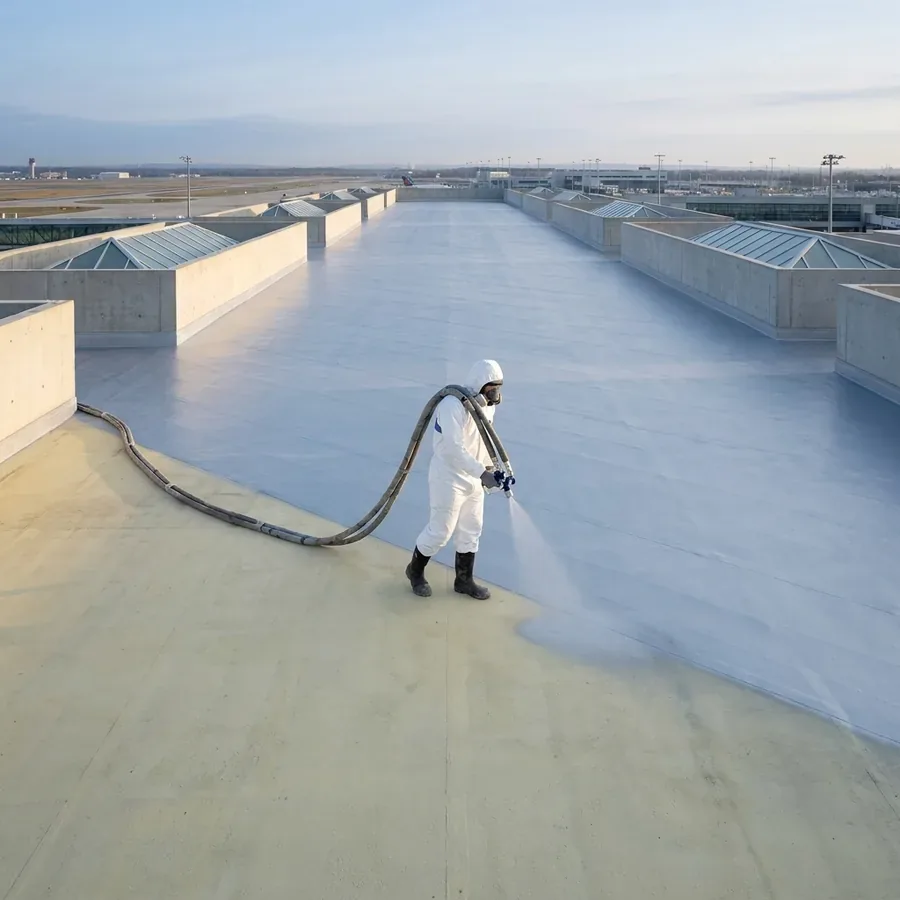
Hot spray polyurea goes on with a plural-component machine that heats both components and pumps them at high pressure. As a result, it gels in seconds. Examples include Polyurea Rayston (pure), Impermax Polyurea H and H Flex (hybrid), and Rayston Spray D50.
Cold applied polyurea, by comparison, is a slower liquid. Applicators roll, trowel, squeegee or conventionally spray it, with no heated rig. Examples include Impermax Cold Polyurea and Impermax Cold Polyurea Supreme.
| Criterion | Hot (e.g. Impermax Polyurea H) | Cold (e.g. Impermax Cold Polyurea) |
|---|---|---|
| Application | Hot-spray rig, 135–170 bar | Roller, trowel or spray |
| Gel time / pot life | Gels in 8–9 s | 180/60/30 min at 5/23/35 °C |
| Elongation | 400% | 600% |
| Tensile strength | 15 MPa | 5.7 MPa |
| European assessment | ETA 11/062 | ETA 17/0509 (10 and 25 years), BBA 11/4836 |
When hot spray polyurea is the right choice
- Large areas. Factory roofs, malls, car parks and bridge decks, since daily output drives cost and programme there.
- Vertical and complex surfaces. Tank walls, foundations and stadium terraces. Because it gels in seconds, it does not sag and builds thickness on the wall.
- Fast return to service. Impermax Polyurea H is rain-resistant after about 15 minutes, while light traffic is possible after about 1 hour.
- Specific approvals. For example, the Polyurea Rayston hot-spray membrane holds WRAS potable water approval. The hybrid H, however, does not.
The trade-off is equipment and skill. The crew must control component and hose temperatures and the mix ratio precisely. Otherwise, a wrong ratio or pressure gives a membrane that does not cure properly.
When cold applied polyurea makes more sense
Krypton’s guidance is clear. Having no spray machine is a valid reason to specify a cold system. However, it is not a reason to rename a hot-spray product as cold, or the other way round. In practice, cold systems suit:
- balconies, terraces and small-to-medium roofs that do not justify mobilising a rig;
- detailing around pipes, plinths and corners;
- repairs to existing hot-sprayed polyurea, a listed use for Impermax Cold Polyurea;
- flat roofs, including blue (rainwater-retention) roofs, and exterior concrete structures.
Impermax Cold Polyurea
The Impermax Cold Polyurea membrane has the following key properties:
- mix ratio of 100:6 by weight, up to 2 kg/m² per coat;
- 600% elongation and crack bridging A5 at -10 °C;
- ETA 17/0509 (ETAG 005, 10 and 25 years), BBA 11/4836 and Broof(t4);
- packs of 25 kg + 1.5 kg;
- substrate at 10–40 °C with moisture below 4%, as well as air RH below 85%.
For background on European Technical Assessments, also see EOTA.
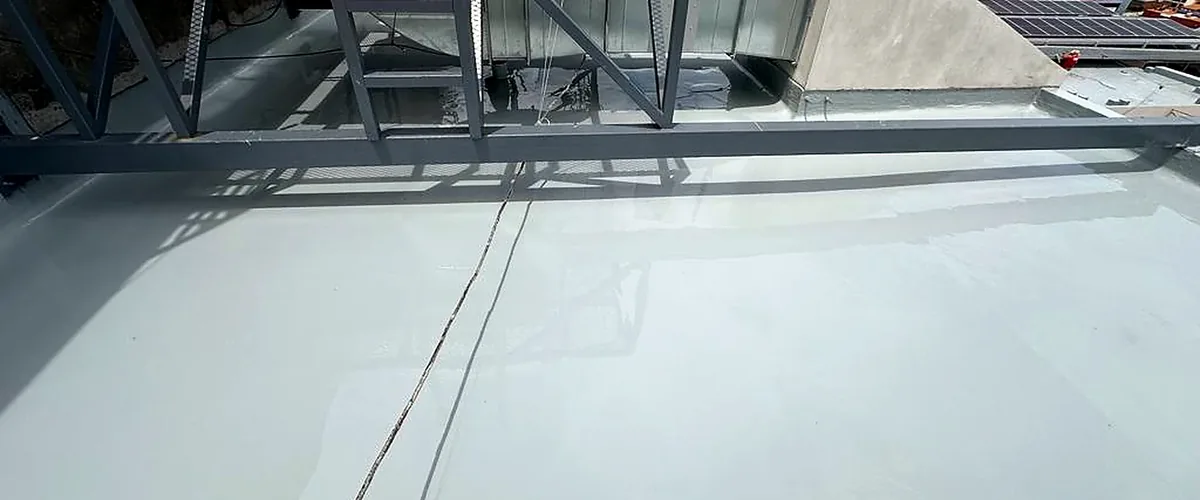
Impermax Cold Polyurea Supreme: solvent-free
Impermax Cold Polyurea Supreme is a two-component cold polyurea. It is completely solvent-free and low in odour, so it also works indoors and in wet areas. According to its TDS:
- mix ratio of 100:170 by weight, with a minimum of 2 kg/m² in one coat;
- pot life of 30 min at 20 °C;
- air at 5–35 °C and RH below 70%;
- light traffic the next day, then full cure in 5–6 days;
- elongation above 950% as well as 12 MPa tensile strength;
- watertight at 60 kPa (EN 1928);
- adhesion of 1.5 MPa, or 2.5 MPa with Epoxy 100;
- service range from -15 to 80 °C;
- CE marked to EN 1504-2 (certificate 0370-CPR-2247).
A hot-climate tip: pot life shortens as temperature rises. For Impermax Cold Polyurea, for instance, it drops from 60 minutes at 23 °C to 30 minutes at 35 °C. So mix small batches and work in cooler hours.
Specification mistakes to avoid
- Writing only “polyurea”, then accepting a cold product as a substitute for a hot-spray one.
- Assuming certificates transfer between products. WRAS, for example, belongs to Rayston only.
- Leaving out the UV finish on exposed roofs.
For a real-world example, see the Cold Polyurea Supreme cool roof project. For local supply, see Impermax Cold Polyurea at Krypton Egypt.
FAQ
What is the difference between hot and cold polyurea?
Hot polyurea goes on with a heated, high-pressure rig and gels in seconds. In contrast, you roll or trowel cold polyurea, and its pot life runs to minutes.
Is cold polyurea weaker than hot spray?
Not necessarily. Cold systems offer higher elongation (600% for Cold Polyurea, above 950% for Supreme). Hot spray, on the other hand, wins on speed, tensile strength and vertical surfaces.
Can cold polyurea repair a hot-sprayed membrane?
Yes. In fact, the Impermax Cold Polyurea data lists repairs to hot-sprayed polyurea as one of its uses.
Do I need a machine for cold polyurea?
No. Instead, you apply it by roller, trowel or squeegee.
No comment