

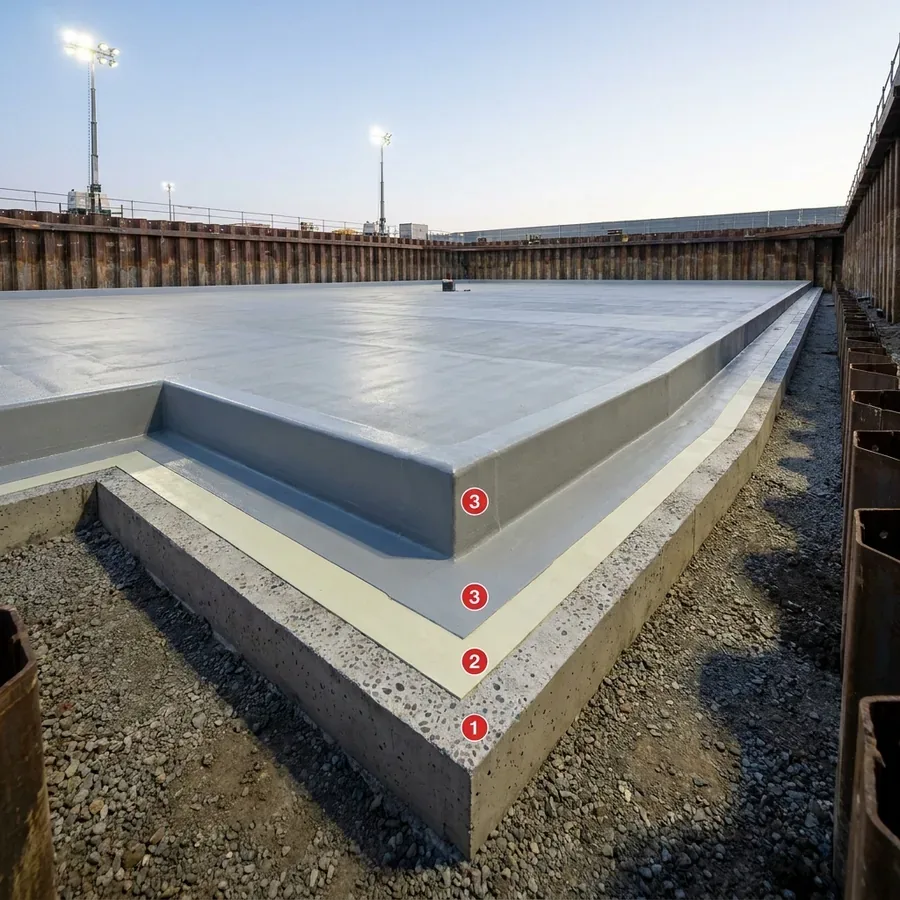
The basement is the hardest part of a building to waterproof, because mistakes stay hidden until after backfilling and finishing, and then they are very expensive to fix. On many sites in Egypt and the wider region, a high water table or saturated soil puts the basement under constant pressure from below and from the sides. Polyurea foundation waterproofing deals with this by forming a seamless membrane from the raft up the walls, with no laps or welds to fail. Krypton’s case note on Polyurea Rayston foundations shows the principle on a real project.
Why basements leak
- Hydrostatic pressure. The deeper the basement sits below the water table, the higher the pressure on the raft and walls.
- Joints and laps. Construction joints between raft and walls, as well as laps in sheet membranes, are the first leak paths.
- Cracks. Shrinkage and differential settlement open cracks, so the membrane must be elastic enough to bridge them.
- Penetrations. Every pipe through a wall is a weak point unless the membrane itself seals it.
How polyurea solves foundation waterproofing
Applicators hot-spray Pure polyurea Rayston as one continuous, joint-free membrane. It runs over the blinding, under the raft, up the external basement walls and around penetrations. According to its TDS, it offers:
- watertightness up to 5 bar, equal to a 50 m water column (EN 12390-8), which gives a wide margin over typical basement depths;
- 324% elongation, 16.2 MPa tensile strength and 69 N/mm tear resistance, so it survives backfilling and structural movement;
- a gel time of about 4 seconds, so it does not sag on vertical walls;
- CE marking to EN 1504-2, together with European Technical Assessment ETA 16/0148.
Does a buried membrane need a UV topcoat?
Not automatically, according to Krypton. Unlike a roof, a buried foundation stops seeing sunlight once backfilling is complete. However, the membrane may sit exposed under strong sun for a long time before backfilling. In that case, plan the programme to keep that period short.
Case study: Real Plaza foundations, Peru
At the Real Plaza Shopping Centre in Piura, Peru, Polyurea Rayston waterproofed 14,600 m² of foundations. It formed a continuous, joint-free barrier under the structure. The same principle also applies to a residential basement or a mall in Cairo. Krypton’s foundation and radon barrier systems page shows which system suits which site.
Rayston Spray D50: when you also need a gas barrier
On some sites the risk is not only water but also soil gases such as radon or methane. This happens, for example, near old landfills or on certain soils. The World Health Organization’s radon fact sheet describes radon as a naturally occurring radioactive gas that accumulates indoors.
For these sites, Krypton offers Rayston Spray D50, a pure polyurea designed as a radon and methane barrier. Its TDS values include:
- radon diffusion coefficient of 8×10⁻¹² m²/s;
- watertightness at 100 kPa (EN 1928) as well as 5 bar (EN 12390-8);
- Shore 55D, 500% elongation, 26 MPa tensile strength and 110 N/mm tear resistance;
- crack bridging A5 at -10 °C and B4.2 at -20 °C;
- 2.5 MPa adhesion;
- CE marking to EN 1504-2 (certificate 0370-CPR-2247), with root resistance to CEN/TS 14416;
- a minimum of 2 kg/m²;
- substrate at 5–40 °C and at least 3 °C above the dew point.
Basement waterproofing steps
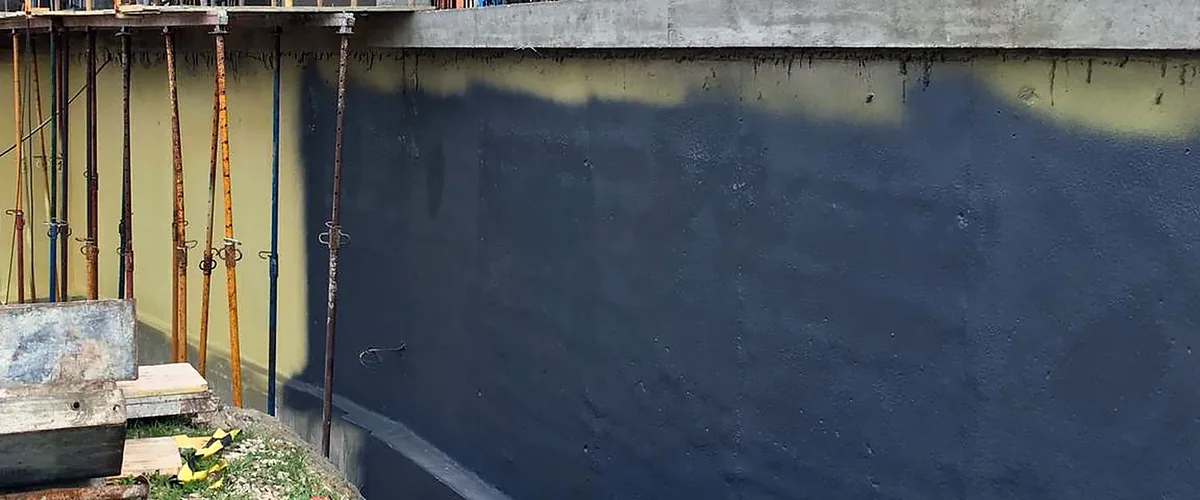
- Dewater. First, lower the groundwater in the excavation, because polyurea cannot go onto standing water.
- Prepare. Remove laitance and dust from the blinding and walls, then measure moisture.
- Prime. Choose the primer that suits the concrete and its moisture content, according to the TDS.
- Spray. Apply the membrane continuously from raft to walls while reinforcing corners and penetrations.
- Protect. Cover the membrane before concreting or backfilling to avoid mechanical damage.
Specification checkpoints
- Do not carry a certificate over to an unrelated use. Rayston’s WRAS approval, for example, covers drinking water tanks and has nothing to do with foundations.
- Name the product explicitly: Rayston for continuous waterproofing, but D50 when the site needs a gas barrier.
- Compare other options in the Krypton Chemical waterproofing range.
For local supply in Egypt, see Krypton Egypt polyurea systems. You can also download data from our technical data sheets.
FAQ
What is the best way to waterproof a basement against groundwater?
Waterproof from the positive (water) side. Use a continuous, joint-free membrane that starts under the raft and then runs up the walls. Hot-spray polyurea does this in one layer.
How much water pressure can polyurea resist?
Polyurea Rayston is watertight up to 5 bar (a 50 m water column) according to EN 12390-8.
Can you spray polyurea on wet concrete?
No. Substrate moisture must stay below 4% with no standing water. In addition, D50 requires the substrate to be at least 3 °C above the dew point.
Do I need a radon barrier?
That depends on a site and soil assessment. If the assessment calls for one, Rayston Spray D50 is the product Krypton designed for it.
No comment